
App Orchid vs. Neo4j: What a Graph Database Does and What a Context Layer Adds
.jpg)
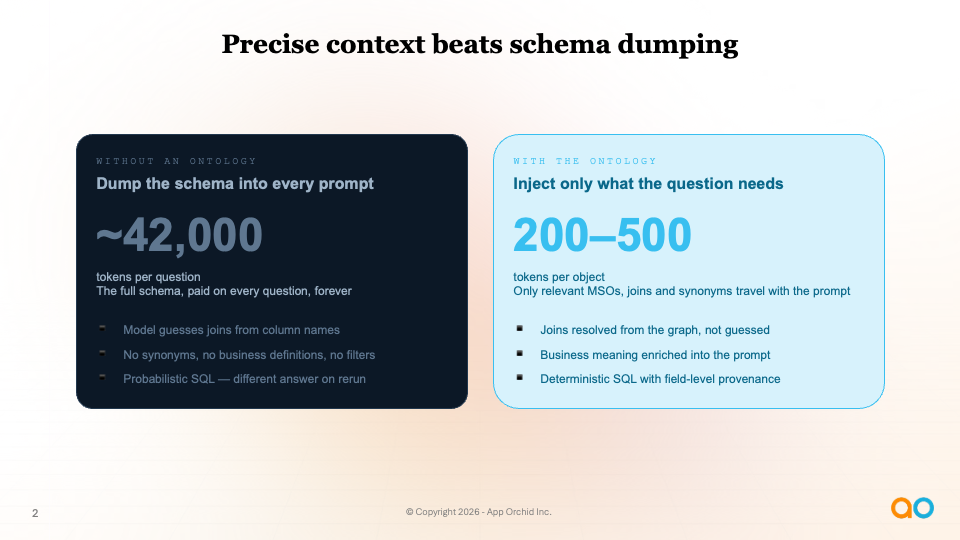
Every LLM query costs money and time, and the cost scales with tokens. Most enterprise AI tools pay that cost on every single question: they stuff schema, sample data, and business rules into the prompt, then ask the model to reason through joins and definitions from scratch. App Orchid avoids most of that cost by moving the work out of the prompt and into the platform.
Most of the savings start before the model ever runs, in what gets put in front of it.
App Orchid's ontology maps business concepts, relationships, and metrics ahead of time. Customer, renewal, margin, region: these are already defined and connected before a user ever asks a question. The LLM doesn't need thousands of tokens of table names and column definitions in context to figure out what "margin" means. It reads intent and maps it to a construct that's already governed and ready.
This also cuts down on retries. When an LLM has to guess at schema meaning, it produces more wrong answers, and wrong answers mean more back-and-forth, which means more tokens. A well-defined ontology gets it right on the first pass more often.
App Orchid doesn't hand the model the entire schema on every question. The platform identifies which segment of the graph the question actually touches, customer and renewal, say, but not inventory or logistics, and sends only that segment as context. A question about churn doesn't pull in supply chain entities. This keeps the prompt small regardless of how large the overall ontology grows, so token cost stays tied to the complexity of the question, not the size of the enterprise data model behind it.
Standard retrieval-augmented generation pulls chunks of a document and hopes the right passage landed in the window, often grabbing more text than the question needs just to be safe. App Orchid takes a different path with unstructured content: it converts documents into structured data up front, using entity extraction to pull out the concepts and relationships that matter, and stores them in the graph alongside structured data. That puts App Orchid closer to GraphRAG than classic RAG. The model gets specific entities and relationships instead of paragraphs of text it has to re-parse on every question, which is a more token-efficient way to ground an answer in unstructured sources.
Instead of asking an LLM to write raw SQL from scratch, App Orchid translates natural language into Semantic SQL: queries built on governed definitions rather than improvised logic. The model isn't reasoning through what columns to join or how to calculate a metric. It's selecting from definitions that already exist. That's a smaller, cheaper task than freeform text-to-SQL, and it produces more consistent results.
Some questions don't need a model call at all, or only need one once.
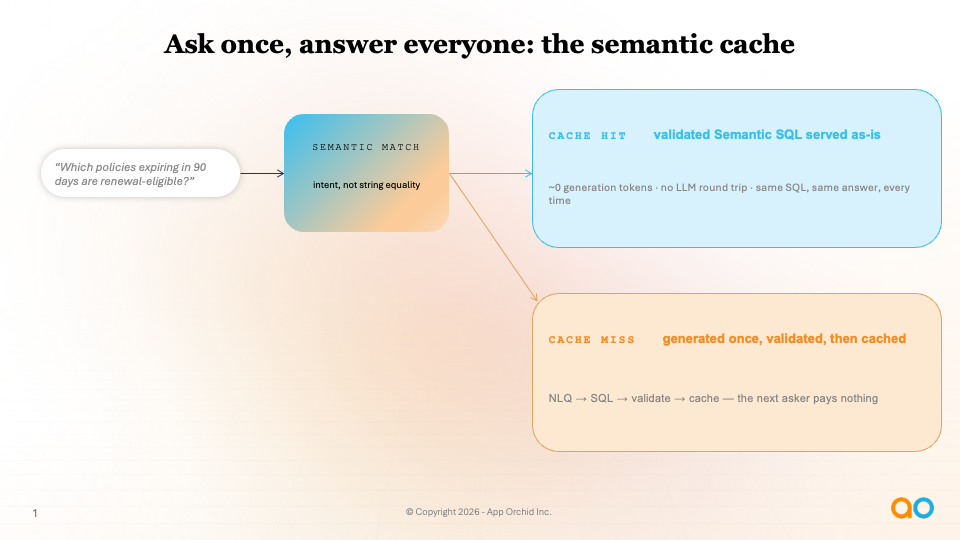
Many business questions repeat, just with different filters or dates. App Orchid matches incoming questions against a library of templates with pre-approved SQL behind them. When a question matches a template, the platform runs the approved query directly. No tokens are spent, because no LLM call happens at all.
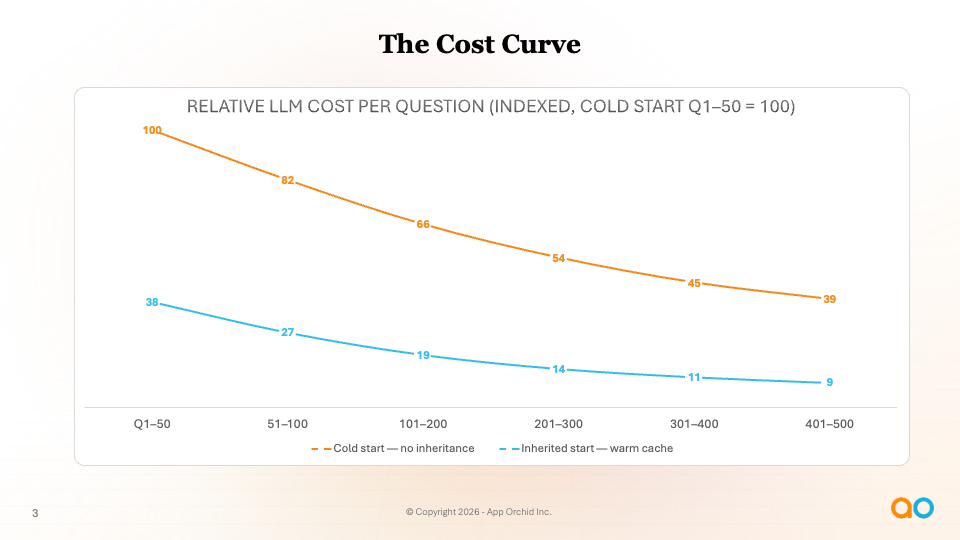
When a question gets answered correctly, App Orchid caches the SQL that produced it. The next time that question (or a close variant) comes in, the platform reuses the cached query instead of asking the model to reconstruct it. Token spend on repeat questions drops, and the same question returns the same query every time.
Compute has to match the task, both in model size and in how many agents get involved.
Not every task in the pipeline needs the largest, most expensive model available. App Orchid's Composable AI Suite lets you configure different models for different tasks: a smaller, lower-cost model for something like summarization, a high-performance model for complex query generation. Instead of running every task through the same model regardless of what it's doing, App Orchid lets you match model choice to task type, so the expensive models are reserved for the work that actually needs them.
A common pattern in agentic AI is spawning a new sub-agent for every subtask, and each one carries its own system prompt, tool schemas, and copy of the context. That overhead compounds fast on a multi-step question. App Orchid runs on a precise, well-defined agentic chat with governance built in, so answering a question doesn't require standing up and coordinating a fleet of agents. Where App Orchid does use multiple agents, for a Data Discovery Agent working alongside an Analytics Agent, it hands off a distilled summary rather than the full conversation history, so the next agent doesn't pay the token cost of re-reading everything that came before it.
None of this holds up if it's expensive to keep current.
None of this works if the ontology takes months of manual modeling to build or update. App Orchid auto-discovers most of the ontology from existing schema and data, and every correction a user makes feeds back into it. The system gets better at matching templates and reusing cached queries over time, without a team hand-writing definitions for each new question type.
App Orchid saves tokens by skipping the LLM, or an expensive one, wherever the job doesn't call for it. Templated questions skip the model entirely, repeat questions pull from cache, and routine lookups route to a smaller model. Everything else draws on only the slice of the semantic graph the question actually needs, structured entities instead of raw document text, and a single governed agent instead of a coordinated swarm. Costs stay tied to question complexity instead of climbing with usage.


Experience a future where data and employees interact seamlessly, with App Orchid.
.jpg)
.jpg)