Who Should Own Your Enterprise Context Layer?
.png)
Most companies are stuck. They want to use GenAI for business intelligence, but they hit a wall: their data makes no sense to an LLM. Standard databases are full of cryptic column names like CUST_ID_01 or TXN_AMT_NET. Only the most technical users know what it means.
Even worse, companies have rarely codifed their language, so there’s no shared understanding of common terms. For example, “critical” means very different things in sales, service, and supply chain.
The common response is to build a semantic layer. If you’re following what experts are starting to recommend, it's to build an ontology. While traditional semantic layers focus on metrics and labels for reporting, ontologies model how business concepts relate to each other across systems, teams, and processes. They give AI a way to reason, not just query.
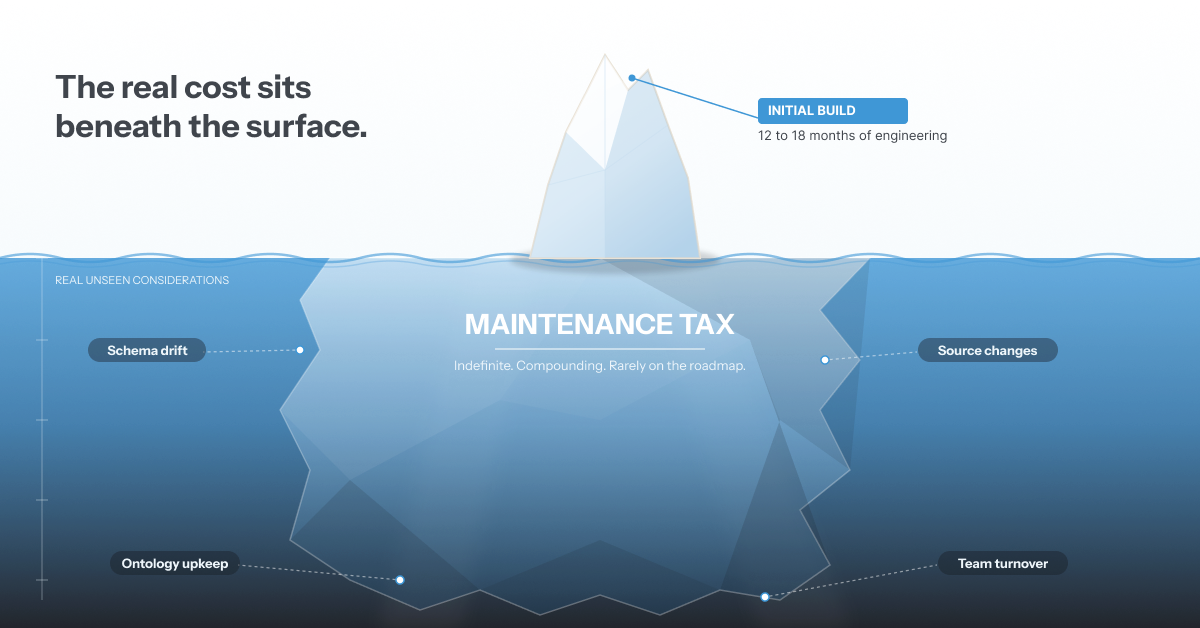
Building an ontology typically involves hiring expensive consultants to interview business users, map every table by hand, and write down definitions. This often takes months. By the time it’s done, the data has already changed.
The industry relied on "semantic layers" to bridge the gap between messy data and BI. Snowflake and Databricks are now betting on that same approach to close the gap with AI through initiatives like OSI. But most companies find markup-language–based semantic layers brittle and hard to maintain, especially amid system changes, M&A, and evolving business processes.
Big players like Palantir and Microsoft are pushing the importance of ontologies. Palantir recently highlighted that 99% of problems solved on their platform are solved through the ontology.
But there is a catch. In systems like Foundry or Fabric, building these relationships is often still a manual, high-effort task. Users report that without strict governance, these ontologies quickly turn into swamps where specific, one-off objects clutter the system and break the logic.
We don't believe in manual labor for machine-level tasks. App Orchid platform performs an Automated Ontology Discovery and Enrichment. Instead of starting with a blank slate, our system "reads" your database schema, analyzes the actual data, and suggests a candidate ontology. This is why the shift toward Automated Ontology Discovery is becoming a baseline requirement for any serious AI roadmap.
The goal is to automate the "grunt work" that currently eats up 80% of their project timeline. Here's how that looks in practice:
While other approaches spend weeks on blueprints and code, we focus on speed and precision, providing a working foundation in hours. automation isn't just faster to build — it's cheaper to run
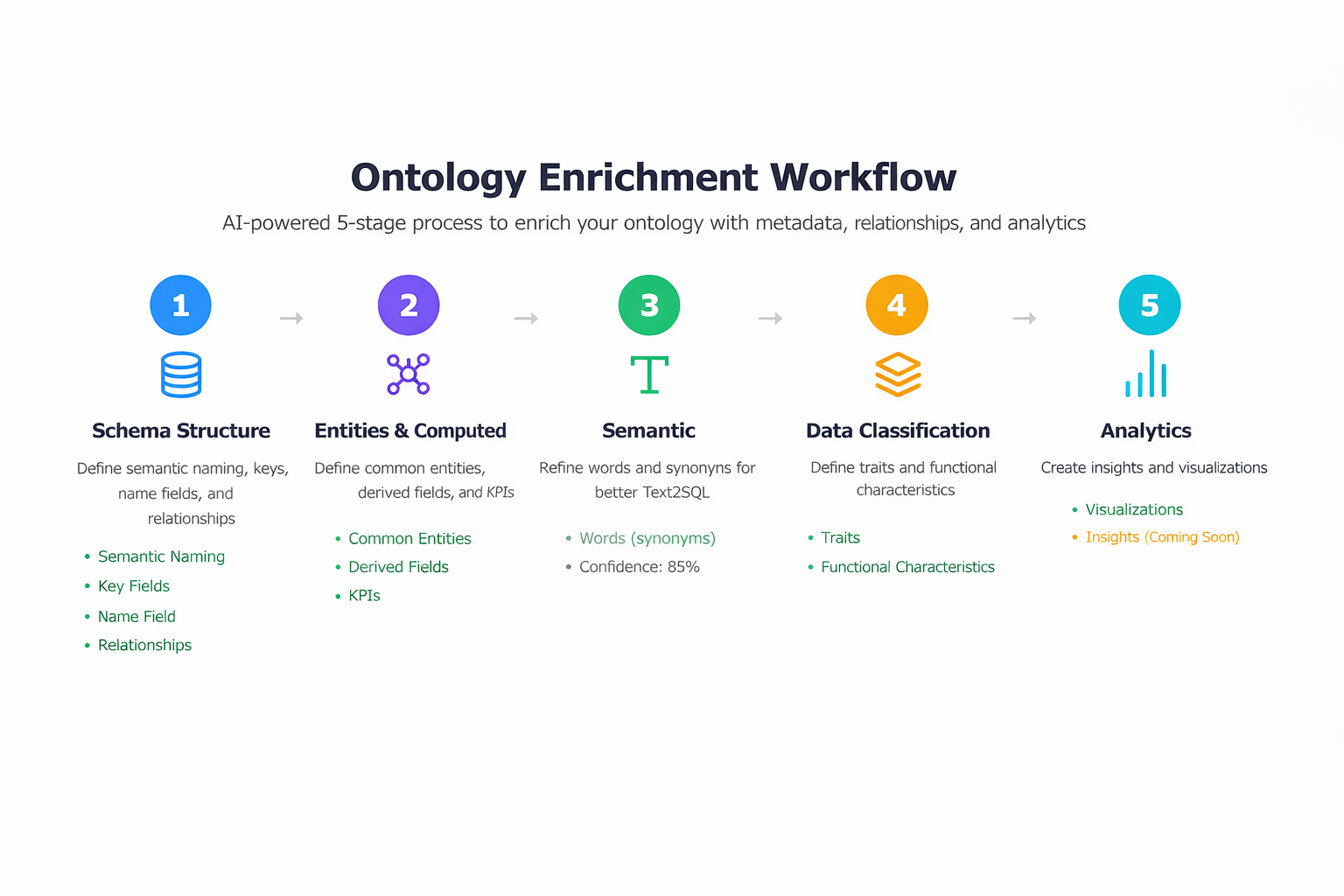
Here is the workflow:
Discovery runs as background tasks, with progress and results visible through notifications. The resulting ontology can then be reviewed, validated, and refined by the human in the loop.
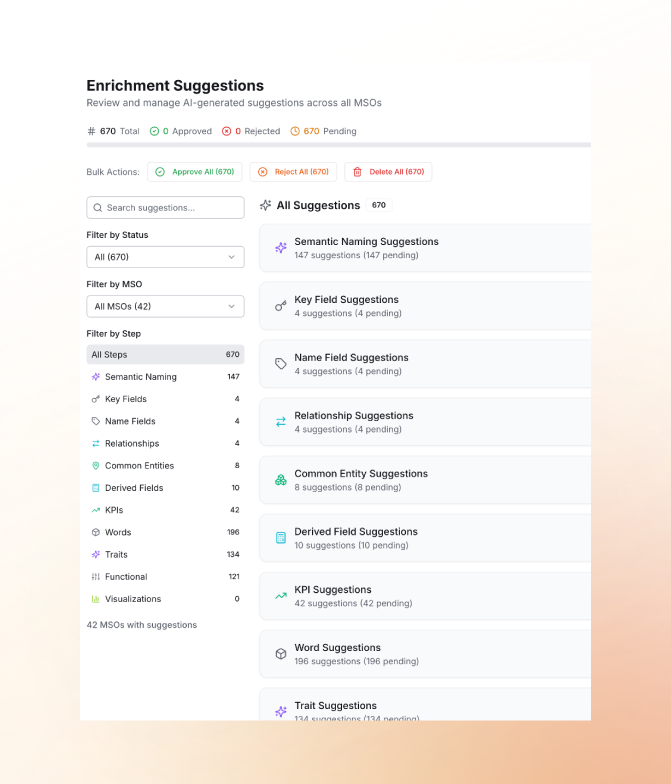
Automation gets you 90% of the way there. The final 10% comes from your team's unique business knowledge. The platform presents a list of "Human in the Loop" tasks:
The semantic ontology we are building isn't static. The system learns with usage. With every new question, every clarification and every new piece of data, the system enriches it.
If the LLM struggles with a specific term, a human clarifies it once in the ontology, and the AI never makes that mistake again. This iterative enrichment is how we achieve 99.8% accuracy on complex natural language queries such as the Spider 1 data set.
The shift from "data to insight" used to take a quarter. With App Orchid, it could take just a week or two. For example, for our Google Cortex for SAP build, we spent two total weeks to build an enriched ontology of a reference SAP system. the timeline looks like this:
The CLI (Command Line Interface) acts as a guided command layer over the AppOrchid ontology platform, letting a technical team point it at a source database and have it work through a structured, multi-stage process - profiling the raw tables, proposing business-friendly names and groupings, mapping keys and relationships between tables, and then classifying which fields represent core business entities, codes, or values worth surfacing to non-technical users. Rather than making a single automated pass, it produces a set of review checkpoints (essentially draft "blueprints" of the proposed business model) where a person confirms names, relationships, and terminology before anything is written to the live system; once approved, the same tool applies those structural definitions and then layers in the everyday business vocabulary and synonyms people would naturally use when asking questions. The net effect is that a raw, technical database schema is progressively "enriched" into a governed ontology - a business-readable map of entities, relationships, and terminology that end users can later query in plain language, with every step verified against the live system and reversible if a check fails, rather than relying on one-shot automated inference.
App Orchid customers using the CLI tool get a candidate ontology in under a day.
Stop building blueprints and start getting answers. Automated discovery is the only way to keep up with the speed of your business. This approach is superior for three reasons:
Enterprise AI doesn’t fail because models aren’t smart enough. It fails because the data they’re asked to reason over has no shared meaning. Manual ontology building was a necessary step in the past, but it simply can’t keep pace with modern, fast-changing data environments.
Automated Ontology Discovery changes the equation. It turns semantics from a one-time project into a living system that evolves with your business. Instead of spending months defining what your data might mean, you start getting answers based on what it actually means today.
That’s the App Orchid way: less manual work, more shared understanding, and AI that finally operates with business context baked in—not bolted on later.


Experience a future where data and employees interact seamlessly, with App Orchid.