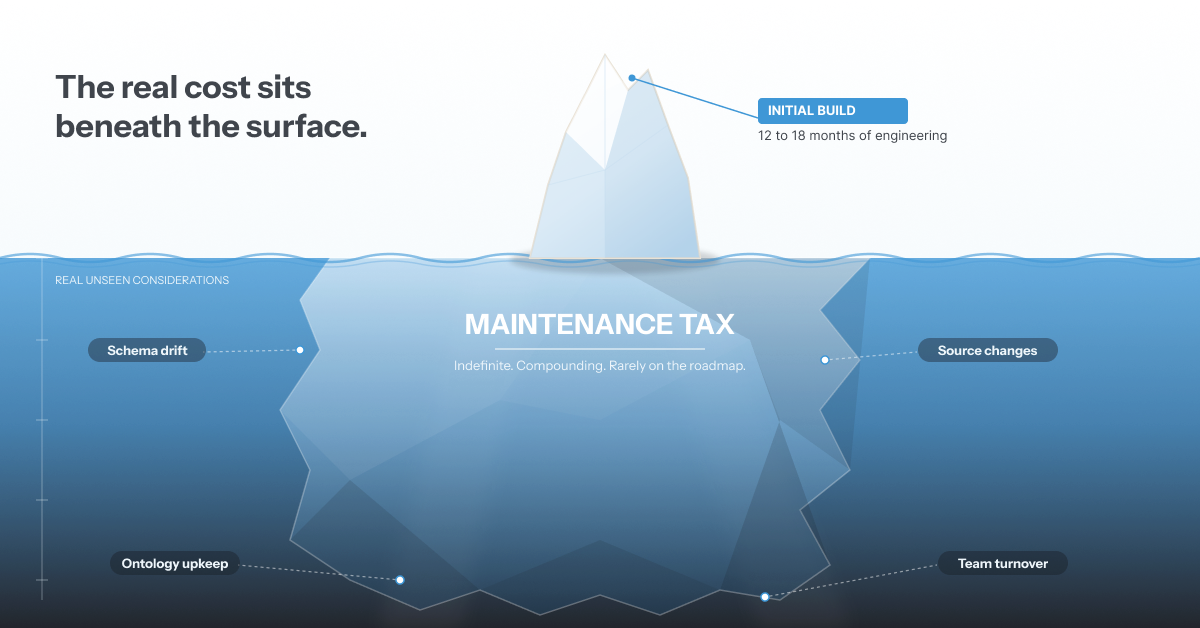
Who Should Own Your Enterprise Context Layer?
At the World Economic Forum in Davos 2026, Satya Nadella issued a warning. He said, “If you're not able to embed the tacit knowledge of the firm in a set of weights in a model that you control, by definition you have no sovereignty. That means you're leaking enterprise value to some model somewhere."
His message was blunt, and it should terrify any leader still playing by the old rules: If you rely solely on third-party models, you are "renting intelligence." More than just technicalities, what he warns of is a strategic crisis. When you "rent" intelligence, every prompt you refine and every dataset you feed into a public model increases your risk of “value leakage.”
You are handing your competitive advantage to your rivals on a silver platter (after all, aren’t they using the same AI models from Google, Anthropic, or OpenAI as you?). Nadella was unequivocal: physical data centers are table stakes, while the real battleground for long-term dominance is controlling the weights of the model (the logic, the definitions, the "tacit knowledge" that makes an LLM tuned to your unique business).
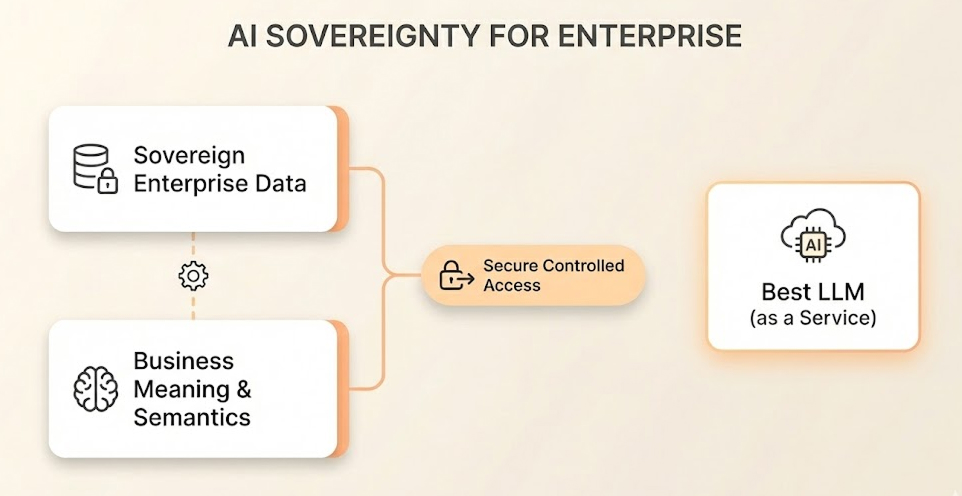
You don't need to bankrupt yourself by building a trillion-parameter model. You need to unlock your data in a way that you control by codifying your business in a manner that AI can understand.
Here are the 3 unlocks form AI sovereignty that will separate the enterprises of the future from those who will be left behind.
The Strategic Gap: Data without meaning is noise. If your definitions of "Churn," "Asset," and "Risk" are trapped in proprietary vendor code (SAP, Salesforce), buried in static PDFs, or hidden in the minds of employees, then you do not own your business logic. You are leasing it.
The Sovereign Solution: Take Back Your Language.
Nadella demands that we embed "tacit knowledge" into weights. This is an expensive proposition.
AI models are a commodity that your competition has access to. Short of fine-tuning models at absurd costs, your best bet is to own the best possible context.
We recommend codifying that knowledge in your ontology and semantics. This unlock is about aggressively building a semantic layer that maps your specific business reality.
By defining your business concepts as central and independent of the underlying applications, you create a digital twin of your organization's logic. This ensures that when an AI model answers a question, it uses your definition of "profitability," not a generic approximation it learned from the open web. This is the only way to prevent value leakage: you keep the "knowledge" of your business inside your own walls, regardless of which LLM processes the syntax. This is the the easier path to "controlling the model parameters" that Nadella emphasized.
The Strategic Gap: Nadella warned that "black box" solutions are trust-killers. If a user asks a critical business question and receives a probabilistic guess, only experts can validate it for trust and you have no audit trail. You have "rented" an answer you cannot verify, and in high-stakes industries, that is a liability you cannot afford.
The Sovereign Solution: Kill the co-pilots, Demand the Truth.
Unlocking this is about democratizing access via natural language querying (NLQ), but with a non-negotiable requirement: transparency.
True sovereignty means empowering every employee, from the shop floor to the C-suite, to ask, "Why are maintenance costs trending up in Texas?" and receive a precise, traceable answer. Because App Orchid’s platform is grounded in your semantic layer (Unlock 1), it understands the intent of the question and the meaning of the data to give you an explainable answer with the highest accuracy and governance.
This is about convenience and control. When you own the semantic layer, you can trace exactly why the AI gave a specific answer. You aren’t hoping the model is right; you know it’s right because it cites your data and exposes its logic.
The Strategic Gap: The industry is rushing toward "Agentic AI", autonomous bots that plan and execute tasks. But let’s be clear: agents running on rented intelligence without deep context are not assets; they are dangerous. They will hallucinate, they will plan poorly, and they will fail.
The Sovereign Solution: Optimize for Understanding, Not Just Storage.
Unlocking this is about dominating the agentic future by ensuring your AI agents possess deep context.
Standard data warehouses are built for storage. To achieve the long-term strategic advantage Nadella described, you need an architecture built for meaning. When an autonomous agent decides to "reorder parts," it must understand the complex, nuanced relationship between inventory levels, supplier lead times, and production schedules.
This is where Ontologies shine. Ontologies can capture the business context as well as the relationships between your data representing your business. By owning this logic in your ontology, you ensure that your agents act as sovereign extensions of your workforce, executing tasks based on your rules, your constraints, and your strategies.
Microsoft gets this, so they've launched an ontology builder in Fabric IQ. Here's why that a step in the right direction, but we think we can do better.
Satya Nadella is right. The era of "renting intelligence" is a strategic dead end. The companies that lead the next decade will be the ones who successfully embed their own tacit knowledge into a system they control.
The question for 2026 is simple: When your AI helps you make a decision that defines your quarter, whose context is it using - yours or your vendor’s?


Experience a future where data and employees interact seamlessly, with App Orchid.