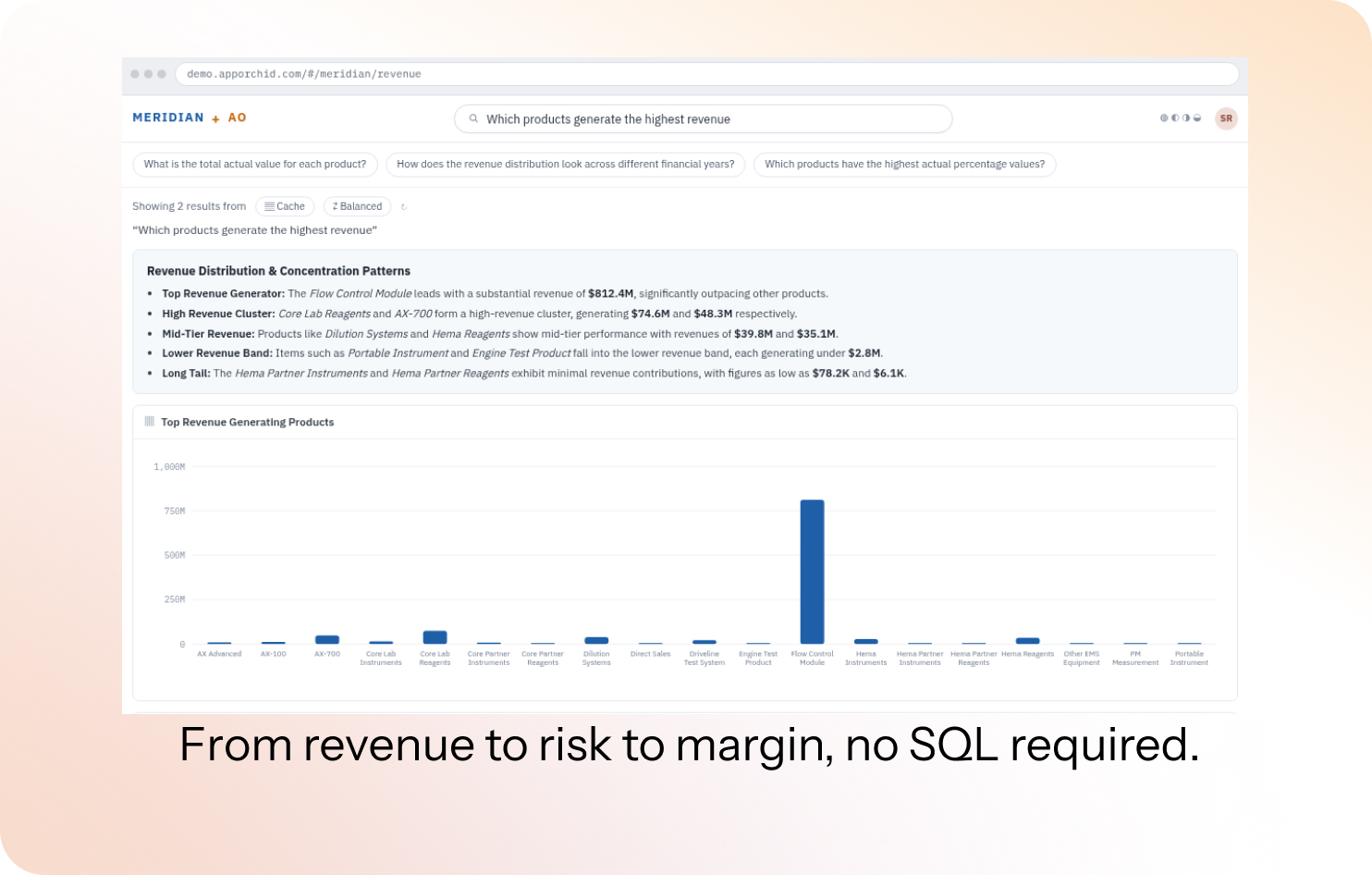
User Journey: Context Layers Enable Faster Decisions

Most manufacturers already understand AI’s potential. The question that keeps every VP of Operations, VP of IT, and plant manager up at night is not whether AI works — it is how to start without a $5M initiative, how to prove ROI before the board loses patience, and how to get from a proof of concept to something plant managers use daily.
Blue Diamond Growers, the world's largest almond processor with plants in three different cities in California and nearly 3,000 grower members, faced exactly this question. Their answer produced one of the most practical AI deployment frameworks in food manufacturing.
Manufacturers don’t have an AI adoption problem — they have an execution problem. According to MIT's State of AI in Business 2025 report, approximately 95% of enterprise generative AI pilots never deliver measurable ROI or scale beyond the pilot stage. The manufacturers that beat this statistic share one common approach: they start small, prove fast, and build from there.
Before exploring the path to success, we need to understand why so many AI initiatives fail. The reasons are predictable, repeatable, and avoidable and identifying them upfront is the difference between a pilot that delivers value and one that quietly dies in the pilot phase.
The most common mistake is scoping an AI initiative around a vision rather than a problem. 'We want AI-powered operations intelligence across all three plants' is not a starting point — it is a destination. Trying to solve everything at once results in solving nothing at all.
Blue Diamond's VP IT, Steve Birgfeld drew a hard line at the start: one use case, one clear KPI, one definition of success. The ambition can be broad. The first deployment has to be narrow.
Most AI projects treat data preparation as a phase. A precondition to complete before the real work begins. That phase has a way of expanding. Months pass reconciling definitions, mapping fields across disconnected systems, and chasing down system owners. By the time the data is "ready," stakeholder patience has run out and the business case has gone cold.
App Orchid eliminates this bottleneck through automated ontology discovery that removes the need for lengthy manual data preparation. Rather than requiring teams to define every relationship between systems by hand, App Orchid's context semantic layer automatically learns the structure of your data — mapping technical database fields to business terms, encoding how operational systems relate to one another, and contextualizing the institutional knowledge that typically lives only in the heads of experienced operators.
When an AI system is asked "What was production efficiency last Tuesday?" it needs a shared definition of "efficiency" that spans every system involved — MES, ERP, SCADA, and beyond. Without that shared context, it guesses. With App Orchid's context semantic layer already in place, that context exists from day one.
The most sophisticated AI model fails if plant managers don't trust its outputs. Trust is built one correct answer at a time and destroyed the first time a system confidently tells an experienced operator something they know to be wrong.
This is why accuracy is the foundation of AI adoption, not an afterthought. App Orchid achieves 99.8% accuracy on the Yale Spider benchmark for natural language to SQL queries. In a manufacturing environment, one wrong answer in five isn't a minor defect to address in the next sprint, it's a breakdown in trust that can derail an entire rollout.
The manufacturing AI deployments that succeed share a simple pattern: one use case with a measurable KPI, data that already exists in operational systems, a context semantic foundation that connects and contextualizes it, and a defined timeline to prove ROI. Everything else is scaling what already works.
What follows is the framework manufacturers can use — reverse-engineered from successful deployment and generalized for any multi-plant manufacturer. Each step has a clear deliverable and a realistic timeline.
The instinct is to start with the biggest problem. Resist it. Start with the problem that has the clearest data, the most measurable outcome, and the fastest path to a result someone in leadership will recognize as meaningful.
Blue Diamond started with unplanned machine downtime. The data was already there. Ignition was capturing real-time machine performance across temperatures, uptime, and utilization. The cost of downtime was already being measured. And the people who cared about fixing it were already paying attention to the metric.
A good first use case has all three of these properties. Use this prioritization framework:
Choose the use case in the top row of your version of this table, the one with the clearest data, the most measurable outcome, and a stakeholder who already cares about the KPI.
The second step is a data inventory, not a data migration project. You are not trying to move data into a central warehouse. You are trying to understand what exists, where it lives, and what connections you need to make.
For Blue Diamond's machine downtime use case, the data map looked like this:
Three systems. All already in production. None connected in a way that enabled the question 'Is this machine trending toward a failure event?'
This is where most manufacturing AI projects take a wrong turn. The instinct is to jump straight to the model by involving machine learning engineers training on historical data and building something that looks impressive in a demo. The problem is that a model built on poorly labeled, inconsistently defined data produces impressive-looking results that fall apart in production.
The semantic foundation comes first. It encodes:
App Orchid's automated ontology discovery builds this foundation by reading your database schemas, analyzing actual data distributions, inferring entity relationships, and surfacing a candidate semantic context layer for human validation.
The human-in-the-loop step matters: subject matter experts validate the system's proposals, confirm joins, and add the tribal knowledge the automated system cannot infer on its own. This is what turns a technically correct model into one that an experienced plant manager will trust.
Ninety days is the outer limit for a first proof of concept. If you are still setting up at week twelve, you need to narrow the scope, not the timeline. The goal of the 90-day sprint is not a polished product. It is a result that a person in leadership recognizes as meaningful and that users on the floor find genuinely useful.
That is what a successful 90-day result looks like. Not a roadmap. Not a pilot program review. A specific person in a specific role making a different decision because of what the system told them.
The metrics to track for a manufacturing AI proof of concept:
This is where the Blue Diamond story becomes particularly instructive. Their second and third use cases were not separate projects requiring separate data foundations. They extended the same semantic layer that powered machine downtime prediction to almond grading optimization and workforce planning.
When Blue Diamond added workforce planning, they connected Kronos time-and-attendance data and Workday employee data to the same semantic foundation that already understood SAP production schedules. The new connections were incremental. The intelligence was compounding.
This is the strategic value of starting with the right foundation. A context layer built once for one use case is reused, not rebuilt, for every subsequent use case. By the time Blue Diamond had deployed three use cases, they had a manufacturing intelligence platform connected across machine performance, product quality, and workforce operations. That platform would have taken years to build if each use case had been approached as a separate project.
A context also reduces what you pay per query — see how.
One of the biggest barriers to starting is a false belief about prerequisites. Here is what a deployment could actually require:
You do NOT need
You DO need
The most important thing to understand is that each use case makes the next one cheaper and faster. The semantic context layer you build for machine downtime prediction already understands your asset IDs, your production schedules, and your organizational structure. The workforce planning use case starts 70% done because the foundation is already there. Starting is more important than starting perfectly.
Ready to run your first manufacturing AI use case? App Orchid's automated semantic context layer connects your existing operational systems — Ignition, SAP, Kronos, Workday, Oracle, Salesforce — and builds the data foundation for your first AI use case in days, not months.
Start with a single use case tied to a KPI you already measure such as machine uptime, workforce efficiency, or quality yield. Identify the data you need and where it lives. Build a semantic context layer to connect and contextualize that data before writing any AI models. Prove ROI in 90 days, then expand.
Predictive maintenance and workforce scheduling consistently deliver the fastest ROI because the data already exists (machine sensors, HR systems) and the cost of failure is measurable.
The most common reasons: starting too broad, inadequate data infrastructure, low user trust, and lack of governance. The fix is starting with one well-scoped use case, building a semantic layer first, and proving ROI before expanding.
With the right foundation, a focused manufacturing AI use case can move from idea to proof of concept in 8-12 weeks.
You need the data that already exists in your operational systems — machine performance data (Ignition, SCADA), production records (SAP, ERP), workforce data (Kronos, Workday). You do not need perfect data. You need a semantic layer that connects and contextualizes what you already have.
Decision intelligence is the application of AI to help manufacturing leaders make faster, more accurate operational decisions. It goes beyond dashboards by enabling natural language questions of operational data and surfacing insights proactively, not just on demand.


Experience a future where data and employees interact seamlessly, with App Orchid.
.png)