Who Should Own Your Enterprise Context Layer?
.png)
Every enterprise AI data architecture, regardless of how it's branded, resolves into three functional layers. Understanding what each layer does — and doesn't do — is the prerequisite for building anything that works in production.
This is where data lives and where queries run. Snowflake, Databricks, BigQuery, Redshift, and their lakehouse variants sit here. So do the data pipelines that move data into them — dbt for transformation, Fivetran or Airbyte for ingestion, and the orchestration frameworks that keep everything current. The storage layer is about capacity, performance, and scale. It knows that a column called net_billing_amt_usd contains floating-point numbers. It does not know that column represents recognized revenue, not bookings, and that partnership revenue is excluded from quota calculations. That distinction is not a storage problem.
This is where meaning lives. It's where business metrics get defined — precisely, once, in a place where every downstream consumer uses the same logic. It's where the relationships between data entities get encoded: the fact that a "customer" in Salesforce and an "account" in the ERP and a "subscriber" in the billing platform are the same conceptual entity, mapped differently across systems. It's where the informal, tribal vocabulary of your business gets made machine-readable — where "ARR" and "annual recurring revenue" and "contract value" get resolved to the same metric, and where "at-risk" means something specific rather than whatever the model infers.
The semantic and context layer is also where governance lives for AI. Row-level security, access controls, and audit trails for who asked what and what definition was applied — these belong in layer 2, not tacked onto the application layer.
This is where users and systems interact with data. BI dashboards, self-service analytics tools, natural language query interfaces, AI agents, LLM chatbots, and operational applications all live here. The application layer is where organizations have invested heavily in user experience — and where they feel the pain most acutely when the output is wrong.
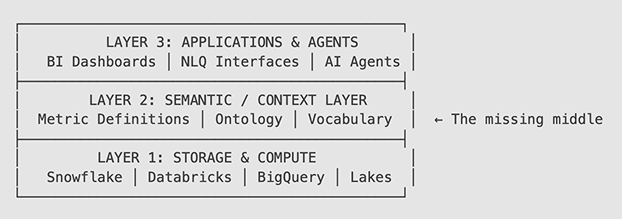
Most enterprises invest heavily in layers 1 and 3. Storage platforms are funded and staffed. Application-layer tools have active vendor relationships, dedicated teams, and executive sponsors. Layer 2 is typically assembled from whatever's available: partial data catalogs, column descriptions that haven't been updated in two years, metric definitions that live in someone's head or a spreadsheet, and prompt engineering that has to substitute for architectural grounding.
This is why AI projects hallucinate. Not because the models are bad — modern foundation models are extraordinarily capable. They hallucinate because they're operating on raw data with no business context. The model doesn't know what acct_status_cd = 'CLO' means. It doesn't know that revenue at this company excludes pilot contracts and one-time fees. It doesn't know that "NGL" in an energy company's data means natural gas liquids, not "not gonna lie." The model makes its best probabilistic guess based on naming patterns and training data. That guess is wrong often enough to make the system untrustworthy.
And inconsistency is often worse than outright error. When the same question returns different answers depending on which tool asks it or how the question is phrased, organizations stop trusting AI outputs entirely. The problem isn't fixed by a better model. It's fixed by a better layer 2.
These terms are used interchangeably by vendors and analysts, but they describe different scopes.
A semantic layer traditionally encodes business metric definitions and dimensional hierarchies. It answers: what does this metric mean? How is revenue calculated? What's the relationship between region, country, and territory? Tools like dbt's MetricFlow, Looker's LookML, and Snowflake's Semantic Views implement this well.
A context layer is broader. It includes the semantic layer but extends it in two critical directions: ontological representation (the machine-readable map of what data entities actually are and how they relate across systems) and business vocabulary and linguistics (the synonym chains, tribal terminology, and contextual meanings that govern how real users ask real questions).
The distinction matters because a semantic layer that defines metrics precisely but doesn't understand the informal vocabulary of your business will still fail when users phrase questions the way they naturally think. A user who asks "how are our stickiest accounts trending" is not going to use the metric name net_revenue_retention_rate. They're going to use the language they use with colleagues. The semantic layer needs a comprehension layer on top of it — and that's what the context layer provides.
App Orchid's position is that the context layer subsumes and extends the semantic layer. You need metric definitions. You also need the ontology and vocabulary layers that make those definitions accessible to AI systems working with natural business language.
Retrieval-augmented generation gets misclassified as a layer-2 replacement. It isn't. RAG is a retrieval mechanism — a way to find relevant content and pass it to an LLM as context at query time. It can live inside layer 2 as part of how the context layer retrieves relevant business rules or documentation. But it isn't the context layer itself.
The difference is meaningful. RAG retrieves. A context layer encodes. RAG can surface a paragraph from a policy document that defines churn. It cannot compute churn consistently, apply that definition across every question about churn regardless of how it's phrased, or enforce that definition as the authoritative one across every tool in the stack. For unstructured content retrieval, RAG is the right tool. For enterprise analytics and AI agent accuracy, it's a component of layer 2, not a substitute for it.
Vector databases have the same relationship to the stack. They're a storage and indexing mechanism optimized for embedding-based retrieval. They belong in layer 1 or as a retrieval substrate inside layer 2. Calling a vector database a context layer is the equivalent of calling a database a semantic layer — it's the wrong abstraction.
AI agents raise the stakes for layer 2 significantly. A BI dashboard that displays a wrong number is a problem. An AI agent that takes the wrong action based on a wrong number is a governance crisis.
Agents need to reason across data, not just retrieve it. A retrieval system that finds the most relevant documents is useful for answering a question. An agent tasked with identifying at-risk accounts, drafting renewal recommendations, and flagging them in the CRM needs to: understand what "at-risk" means in this business context, navigate the relationship between account-level health signals and renewal timing, apply business rules governing which accounts qualify for which intervention, and produce outputs that can be audited and traced back to the definitions that generated them.
None of that is possible without a well-formed layer 2. Agents are the application-layer system most sensitive to the quality of the context layer beneath them. The better the layer 2, the more reliable, consistent, and governable the agent's behavior.
This is not a future consideration. Organizations deploying agents on enterprise data today are discovering this the hard way: the agent works in demos and fails in production when the inputs deviate from the narrow conditions it was tested against. The fix is not a better agent. It's a better context layer.
The phrase "AI-ready data" has been watered down into a marketing term that means almost nothing. Structurally, data is AI-ready when an AI system can:
This is a layer-2 specification. It's not answered by faster storage or a better LLM. It requires a context layer that encodes meaning, relationships, and vocabulary in a form that AI systems can reliably use.
The AI data stack consists of three layers: a storage and compute layer (data warehouses and lakehouses like Snowflake, Databricks, and BigQuery), a semantic and context layer (where business metrics, entity relationships, and vocabulary are encoded), and an application and agent layer (BI tools, AI interfaces, and autonomous agents). Most enterprises build layers 1 and 3 and underinvest in layer 2.
A semantic layer defines business metrics — how revenue is calculated, what dimensions exist, how hierarchies are structured. A context layer includes all of that and extends it to cover the ontological map of data entities (what the underlying data represents and how entities relate across systems) and the business vocabulary layer (the synonym chains, tribal terminology, and contextual language that real users use). The context layer subsumes the semantic layer.
RAG (retrieval-augmented generation) is a retrieval mechanism that can operate inside the context layer to fetch relevant business rules, documentation, or definitions at query time. It is not a replacement for the context layer. RAG retrieves content — it doesn't encode business logic, enforce metric definitions, or resolve natural language vocabulary to defined constructs consistently across the enterprise.
AI systems operating on raw data without a context layer are pattern-matching on column names and schema structure. They don't know what the data means in business terms, how entities relate across systems, or how to interpret the vocabulary real users use. The result is inconsistent answers, hallucinated outputs, and systems that work in narrow demos but fail in production. The context layer is the architectural fix.


Experience a future where data and employees interact seamlessly, with App Orchid.