
App Orchid vs. Neo4j: What a Graph Database Does and What a Context Layer Adds
.jpg)
This isn’t a Snowflake vs App Orchid article. I want to show you why you truly need both.
Snowflake is a genuinely impressive data platform. If you've standardized on it, you've made a defensible architectural choice - strong compute separation, mature governance primitives, a growing AI story, and a partner ecosystem that spans most of the enterprise stack.
However, organizations that are deploying agents and enabling natural language chat with data need accurate, multi-hop, conversational answers out of complex enterprise data. Infrastructure excellence and context intelligence become two very different problems.
Snowflake solves the first one. App Orchid solves the second.
Here's where App Orchid fits vs. data platforms like Snowflake, Databricks, Fabric etc. App Orchid is a unified semantic + context layer that runs above your existing platforms; data is not moved. It's the layer that gives LLMs the business context they need to answer even "simple" questions accurately.
Snowflake's introduction of Semantic Views and Cortex Analyst is a meaningful signal. It confirms what the market has been learning the hard way: AI-driven analytics requires a context layer. Without one, text-to-SQL accuracy against raw schemas is brittle, inconsistent, and ultimately untrustworthy in production.
A Semantic View is a schema-level DDL (Data Definition Language) object. You define it with CREATE SEMANTIC VIEW. It captures facts, dimensions, metrics, join paths, synonyms, verified queries, and custom instructions in a structured YAML-backed specification. Snowflake's own best-practices documentation recommends starting with no more than 10 tables and 50–100 columns per view. Routing across multiple semantic views works, but queries will not join across semantic view boundaries. In other words, each model is self-contained.
It is, however, missing the business vocabulary, linguistics and ontology that's required for answers.
That’s not reflective of how a real enterprise data model works.
A utility company may have a 300-table operational schema. A manufacturer could have billing, logistics, inventory, and CRM data spread across distinct business domains. A financial services firm needs to have regulatory, transaction, and counterparty data in separate systems. You're not going to neatly decompose that into a collection of sub-100-column semantic views and expect Cortex Analyst to reason coherently across them. You will end up building a proliferation of overlapping models, fight routing ambiguity (Snowflake's own docs note that similar descriptions degrade routing accuracy), and end up with a semantic layer that reflects how your data happened to land in Snowflake, not how your business actually thinks. This is a constraint that caused by treating semantics as a first-order database object. Snowflake recently removed these limitations and now recommends one giant semantic view- which creates an impractical monolith at enterprise scale
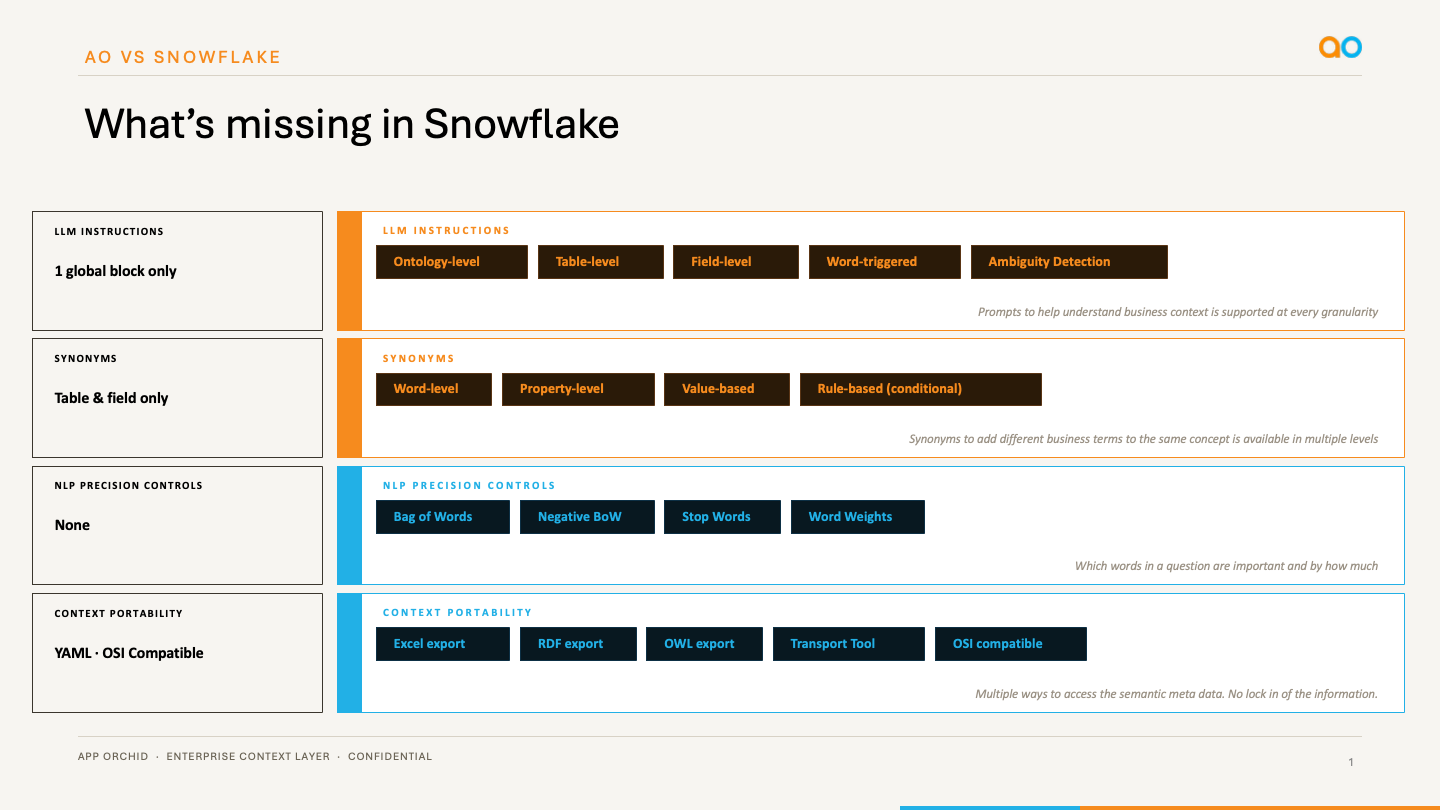
Snowflake's semantic controls stop at column descriptions and word-to-column synonyms. App Orchid goes further in ways that matter in production. For example,
outage_duration > 4 hours and applies it automatically, rather than leaving the LLM to guess. annual_revenue > 1,000,000 AND contract_tier = 'Enterprise' and that compound filter injects itself into any query containing the phrase, governed and consistent every time. 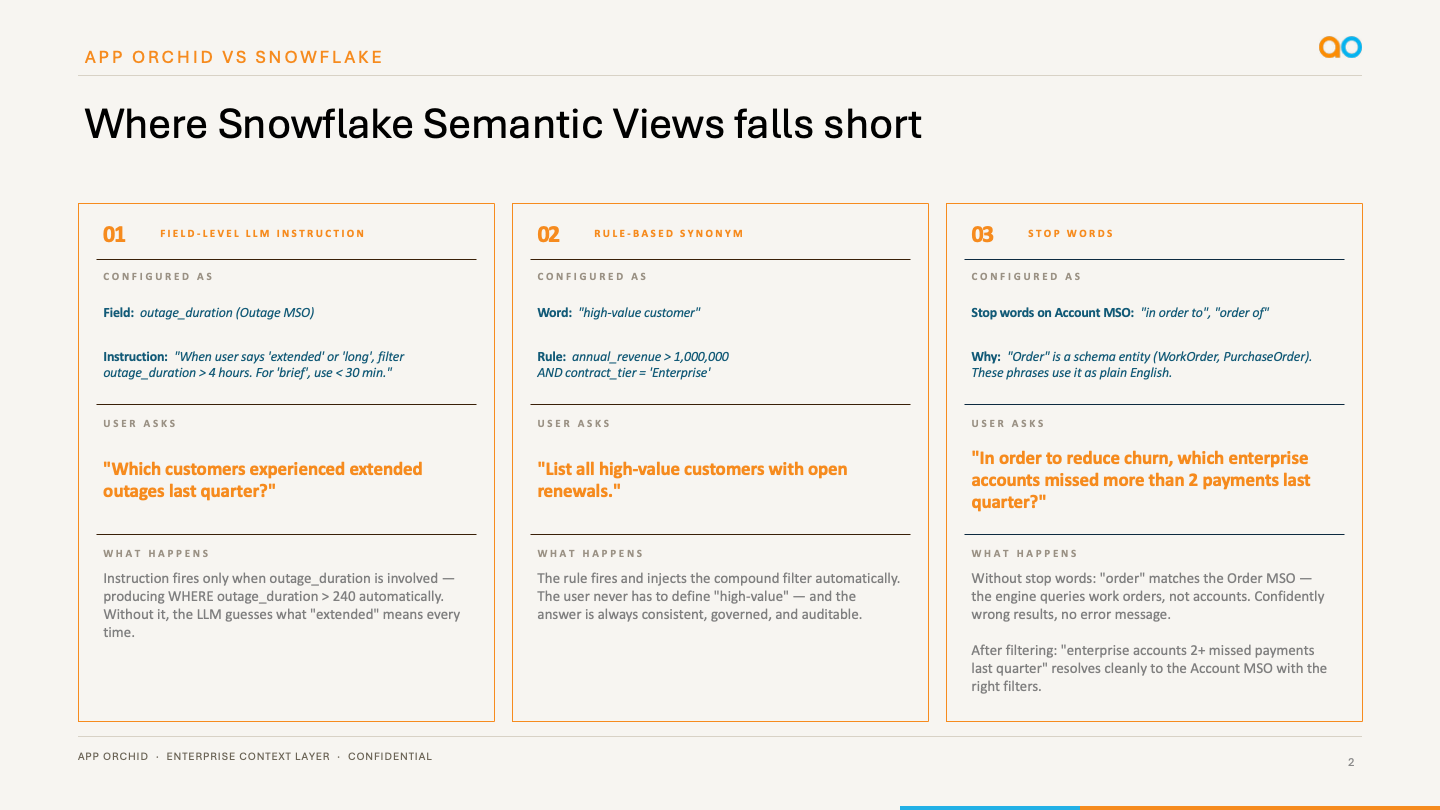
Snowflake offers Semantic View Autopilot - an AI-assisted UI workflow that can auto-generate column descriptions, infer synonyms, and suggest model structure based on existing dashboards or SQL. It's a real productivity improvement over writing YAML by hand.
But the thing about Autopilot is that it accelerates authoring, not discovery. Someone still has to decide which tables matter, which columns to include, which metrics capture the right business logic, and which verified queries should seed the model's reasoning. That work requires someone who understands both the physical data model and the business semantics, a rare skillset.
This doesn’t account for the real time sink, which isn't typing YAML. It's the semantic definition work that has to happen before you even open Autopilot: resolving metric disagreements between finance and ops, deciding whether "active customer" means 90-day active or contract-active, mapping four different field names across three source systems that all mean the same thing. None of that is automated.
Snowflake's best practices guide even warns explicitly: "What happens: stakeholders keep adding 'just one more thing' to the POC."
App Orchid inverts this. Our automated ontology discovery reads your schema, analyzes data distributions, infers entity relationships, and surfaces a candidate ontology. Human reviewers validate and refine. Teams move faster, and the resulting ontology is more complete because it's derived from the actual data. Updated context foundations is just as speedy.
Let's be specific about where Cortex Analyst runs into trouble at scale, because the documentation is refreshingly honest about it: It's SQL-only.
Snowflake's Horizon Catalog is a well-built governance framework. RBAC is consistent across clouds. Classification and tagging propagate through data movement. The Trust Center provides cross-account compliance monitoring. The integration with Apache Iceberg via Polaris enables governance to follow data outside the Snowflake perimeter. These are legitimate enterprise capabilities.
Snowflake is a centralization-first platform. Its value proposition is strongest when data is inside the AI Data Cloud. That's a coherent architecture for greenfield environments and organizations that have completed data modernization.
Most large enterprises are not in that position. They have data in SAP, Oracle, Salesforce, legacy data lakes, and cloud platforms that predate any standardization decisions. Moving that data into Snowflake means migration projects, data quality remediation, ongoing replication costs, and the organizational friction of convincing system owners to let a centralized platform become the system of record for their operational data.
(Note: At Sapphire 2026, SAP and Snowflake announced federation across Snowflake and SAP's Business Data Cloud products. We are eager to see how this plays out in practice.)
App Orchid is federated by design. The context graph doesn't require data to move. It virtualizes intelligence across sources where data lives today. This is a different theory of what a context layer should be. The meaning of your data should be portable and independent of your storage topology. When you migrate a source system, change your warehouse, or onboard a new SaaS vendor, your business semantics won’t require reconstruction.
Snowflake's model ties meaning to the platform. If Snowflake is your entire data estate, that's fine. If it isn't (and for most enterprises, it isn't) you're either accepting partial coverage or taking on the data migration burden that full coverage requires.
Snowflake recently announced Snowflake Intelligence, powered by Cortex Analyst, Cortex Search, and semantic views. This represents their most integrated AI reasoning surface to date. It's designed to let users ask natural language questions and receive answers, visualizations, and agentic actions, all within the governed Snowflake environment.
The market wants this. But at this stage, Intelligence inherits all the constraints of its underlying components. Semantic views need to be built and maintained manually. Cortex Analyst is bounded to SQL-resolvable questions. Cross-domain reasoning is limited by the isolation between semantic view models. And the entire capability surface is constrained to data and metadata that exists inside Snowflake.
There's a dimension to this conversation that deserves more attention in technical evaluations: who owns your business semantics when the work is done?
You can't own the LLMs that power AI reasoning. Your competitors have access to the same models. But the semantic representation of your business - how you define revenue, risk, asset health, customer value, operational efficiency - that is genuinely differentiable. Organizations that build and own that layer have an AI advantage that's durable.
When business semantics are defined as Semantic Views inside Snowflake, they're first-class objects in Snowflake's ecosystem. They leverage Snowflake RBAC, integrate with Snowflake tooling, and benefit from Snowflake governance. But they are also, practically speaking, tied to that ecosystem.
App Orchid's context graph is built for portability. Your ontology travels with you, independent of compute platform, storage location, or downstream tooling choices. When you own your semantics, you own your AI advantage. And that brings us to the most interesting strategic tension in this conversation right now.
In September 2025, Snowflake convened the Open Semantic Interchange (OSI) initiative alongside Salesforce, dbt Labs, BlackRock, RelationalAI, Mistral AI, Google, and AWS. The v1.0 spec shipped January 27, 2026 under Apache 2.0, a vendor-neutral model for representing datasets, metrics, dimensions, and relationships that any compliant tool can consume. OSI's own framing positions it as the foundational context layer for agentic AI, regardless of which platform executes the query. We agree with that framing entirely.
As of today, I am aware of no vendor including Snowflake has shipped native OSI import/export tooling. The working group is still in active specification work. For organizations building semantic layers now and expecting portability later, the path from today's Semantic View investment to tomorrow's OSI-portable ontology is not yet paved.
App Orchid is building OSI compatibility as a first-order architectural commitment, not a future migration project. Our context graph is designed around the same core constructs OSI formalizes, and we intend to be an early mover on OSI import/export as the spec matures. An ontology built with App Orchid today is portable business intelligence from day one.
OSI ultimately validates what the market has been learning: the context layer is real infrastructure, portability and vendor-neutrality are legitimate enterprise requirements, and the lock-in risk for organizations building on Snowflake Semantic Views today is real. Every serious technical evaluation should account for that gap.
The framing of "Snowflake versus App Orchid" is the wrong question for most of the organizations we talk to. These are not competing platforms for the same problem.
Snowflake is an excellent data platform for storage, compute, governance, and increasingly for AI workload execution. If your organization has standardized on Snowflake, that was likely the right call for your data infrastructure needs.
But Snowflake's semantic layer is manual, brittle at scale, SQL-bounded, and Snowflake-native. It is not designed to be the context layer for organizations with complex, federated data environments.
App Orchid sits above the data platform. It builds the context graph, federates across sources, automates ontology construction, and delivers multi-hop reasoning that isn't constrained by SQL resolution or semantic view boundaries. The two are complementary when Snowflake is part of your stack and App Orchid is the necessary layer even when it is.
Think of App Orchid as your enterprise knowledge infrastructure. The system of record for how your business actually works.
Federation across systems: Snowflake's semantic and governance layers only reach data that lives inside Snowflake. App Orchid virtualizes meaning across SAP, Oracle, Salesforce, legacy lakes, and on-prem systems without requiring migration. Source permissions (RLS, document ACLs) are preserved across vendors.
Automated ontology discovery: Snowflake's Autopilot accelerates authoring a Semantic View, but humans still have to decide which tables matter, resolve metric disagreements, and map equivalent fields across systems before they even open it. App Orchid reads the schema, analyzes distributions, infers entity relationships, and surfaces a candidate ontology that humans validate, inverting the workflow.
Cross-domain, multi-hop reasoning: Cortex Analyst can't join across Semantic View boundaries, and Snowflake's own guidance only recently relaxed the limitations of each view at ~10 tables / 50–100 columns. That breaks down for a 300-table utility schema or a manufacturer spanning billing, logistics, inventory, and CRM. App Orchid's context graph reasons across the full enterprise model without those isolation walls.
Reasoning beyond SQL: Cortex Analyst is explicitly bounded to SQL-resolvable questions; it won't synthesize across unstructured context or generate forward-looking insight. App Orchid combines structured data with document grounding for true multi-hop enterprise reasoning.
Encoded business rules and anti-pattern intelligence: Understanding how the business talks about daata and knowing which wrong answers look right. Snowflake governs access; it doesn't encode meaning or business logic.
Incremental, non-destructive maintenance: Semantic Views can't be partially updated; any schema or metric change forces a full rebuild, and Snowsight edits get overwritten by SQL pushes. App Orchid's ontology updates incrementally as the business evolves.
Portability and vendor neutrality — Semantic Views are tied to Snowflake's ecosystem. App Orchid's context graph is portable across compute platforms and is being built around OSI compatibility as a first-order commitment, so the semantic investment survives migrations and tooling changes.
Open consumption surface:JDBC, REST, and MCP access make the ontology LLM-agnostic and consumable by any agent or BI tool, not just Snowflake-native tooling like Cortex Analyst or Snowflake Intelligence.
Snowflake handles storage, compute, and access governance for data inside its platform. App Orchid adds the cross-system meaning, federation, and reasoning layer that makes that infrastructure AI-ready.
App Orchid isn't a replacement for Snowflake. For organizations that have invested in Snowflake infrastructure, App Orchid is the context layer that makes that investment AI-ready.
The data platform is the foundation. The context layer is the intelligence. You need both - Let's talk.


Experience a future where data and employees interact seamlessly, with App Orchid.
.jpg)
.jpg)