
Who Should Own Your Enterprise Context Layer?
In June 2023, Andreessen Horowitz published a piece that articulated what practitioners had been circling for months: the enterprise AI stack has a critical missing layer between raw data and AI applications. A16z called it the "context layer" — the infrastructure that encodes business meaning, relationships, and knowledge in a form that AI systems can reliably use. The framing resonated. Within twelve months it had become the organizing concept for a wave of platform announcements, from Databricks Genie Ontology to AWS Context.
Two years later, the category is validated. The practical question most enterprise data and AI leaders are now sitting with is: do we build this, buy it, or stitch it together from the parts we already have?
This post is an attempt to answer that question honestly. Not as a vendor pitch. As a structured decision framework — one that respects the legitimate case for building while being clear-eyed about what it actually costs.
Build vs. buy is the wrong question. The right question is: build vs. buy vs. stitch — because most organizations that decide to "build" a context layer end up in the third category without realizing it.
Building implies constructing something cohesive from scratch with a clear architecture. What typically happens is different: a team assembles a collection of point tools — dbt for metric definitions, a data catalog for documentation, a vector database for retrieval, a graph database for relationships, a custom prompt engineering layer, a metadata API — and spends 18–24 months learning the hard way that the integration surface between these tools is where the real work lives. The result is a stitched system that is fragile at the seams, difficult to extend, and nearly impossible to maintain as business logic evolves.
The a16z framing is useful here: what does a context layer actually need to do? It needs to connect to data wherever it lives, encode business meaning in a governed and queryable way, serve both LLMs and traditional analytics consumers, and stay current as data and business logic change. Most "build" decisions underscope this. They plan for retrieval and skip reasoning. They plan for metadata and skip vocabulary. They solve the demo case and ship something that breaks at the edges of production.
The case for building is real. You control the architecture. You own the output. You can tune for your specific data landscape and business requirements in ways no vendor platform will exactly match. For organizations with genuinely proprietary ontological requirements — deep vertical-specific knowledge, highly custom entity models, regulatory constraints on data movement — building may be the only option.
But the true cost of building is systematically underestimated. Here's what goes into a production-grade context layer:
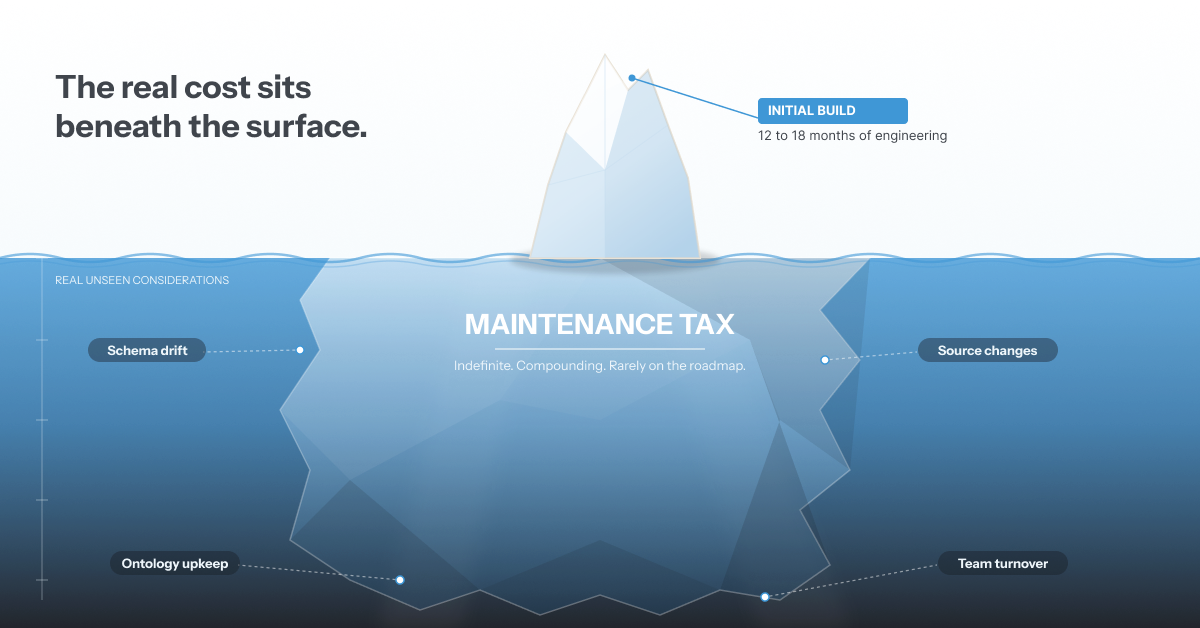
Engineering time. Building something production-grade — with connectors to your data sources, semantic enrichment, ontology management, access control, query federation, and an interface layer for LLM and agent consumers — is a minimum 12–18 month engineering investment for a well-resourced team. Most teams that attempt it are not solely allocated to this work. They're building alongside their existing responsibilities. In practice, 18 months becomes 24–30, and the scope shrinks to accommodate the timeline.
Maintenance as a permanent tax. Data changes. Business logic changes. New sources get added. Existing definitions get revised. A built context layer doesn't update itself. Every schema change, every new product line, every acquisition, every metric redefinition is a maintenance task. The team that built the system becomes the team responsible for keeping it current — indefinitely. That maintenance load compounds as the system grows and as the engineering team that understands it turns over.
Opportunity cost. Your data engineers are not building domain intelligence while they're building infrastructure. Every sprint spent on ontology management tooling is a sprint not spent on the analytics products and data features that differentiate your business. This cost is real even when it's invisible on the roadmap.
The "almost there" trap. Teams get 70% done and ship. The system works for the use cases it was built for. It breaks on questions outside those use cases — and because it's embedded in production workflows, it's too fragile to expand but too embedded to replace. The organization lives with a system that partially works and fully constrains. This is the most common outcome of enterprise build decisions on context layer infrastructure.
A vendor platform for the context layer is not without real costs. Intellectual honesty about these tradeoffs is what makes the eventual recommendation credible.
Integration effort. Vendor onboarding requires real work. Connecting your data sources, mapping your entity model to the platform's schema, validating the initial context layer output against your business logic — this is not a turnkey process. The advertised time-to-value is typically optimistic about the discovery and validation work required. Plan for a realistic onboarding runway.
Lock-in. This is the legitimate concern, and it deserves a direct answer. The relevant question isn't whether lock-in exists — it does, with any platform — but whether your semantic models and ontological definitions are portable if you change vendors. When evaluating: can you export your metric definitions in a standard format (YAML, JSON-LD, RDF)? Can you access the ontology through an API that doesn't require the vendor's runtime? Is the knowledge graph in a format you own? Lock-in is acceptable if the data is portable. Lock-in to opaque proprietary representations is a different and more serious risk.
Customization ceiling. Every platform has an opinion about how context layers should be structured. For most enterprise use cases, that opinion is close enough to your requirements to be workable. For organizations with deeply proprietary ontological requirements — highly specialized verticals, unusual data models, regulatory constraints that conflict with the platform's architecture — the customization ceiling is real. Evaluate specifically whether the platform's data model can accommodate your actual entity types and relationship rules before committing.
This framework is not "it depends" with extra steps. It's designed to give you a real answer.
App Orchid is built on the a16z architecture: the premise that the context layer is the critical missing infrastructure between raw data and AI applications. The platform implements this architecture end-to-end — ontology management, semantic enrichment, vocabulary and linguistic comprehension, 150+ connectors to enterprise data sources, query federation across systems, and LLM and agent interfaces out of the box.
The specific differentiation is in how the context layer gets built. Most enterprise platforms — Databricks, Snowflake, Google, Microsoft, AWS — require either manual authorship (developers write the definitions) or inference from usage patterns (the system learns from queries but can't generate what hasn't been queried). AppOrchid uses agents to generate a candidate context layer from the actual data: schema crawl, relationship inference, metric discovery, vocabulary mapping. Domain experts validate rather than author from scratch. The authorship burden shifts from construction to review.
The result is a production-grade context layer in weeks, not months — one that reflects the actual state of your data landscape rather than a theoretical model built on whiteboards. For enterprises that need AI use cases in production this year, and that don't have a dedicated team to build and maintain context layer infrastructure indefinitely, that's the relevant answer to the build vs. buy question. Let's talk.
For a production-grade system — with connectors to your data sources, semantic enrichment, ontology management, access control, query federation, and LLM/agent interfaces — budget a minimum of 12–18 months for a well-resourced team solely dedicated to this work. Most teams are not solely dedicated. In practice, 18–30 months is common, with scope reductions along the way. Purpose-built platforms can compress this to 4–12 weeks for initial production deployment, depending on the complexity of the data landscape and the extent of human validation required.
A semantic layer encodes metric definitions and dimensional hierarchies — how revenue is calculated, what segments exist, how hierarchies nest. A context layer includes that and extends it to cover the ontological map of data entities (what the underlying data represents and how entities relate across systems) and the business vocabulary layer (the synonym chains, tribal terminology, and contextual language real users use). The context layer is the complete infrastructure; the semantic layer is one of its three components.
It creates platform dependency, which is different from vendor lock-in in the most damaging sense. The relevant question: are your semantic models and ontological definitions exportable in standard formats? If yes — if you own the definitions and can take them elsewhere — the risk is manageable. If your context layer lives in opaque proprietary representations accessible only through the vendor's runtime, that's a more serious lock-in. Evaluate portability explicitly, ask for data export in open formats as a contractual requirement, and verify that your entity definitions and metric logic can be expressed outside the platform's native tooling.


Experience a future where data and employees interact seamlessly, with App Orchid.

.png)