Build vs. Buy an Enterprise Context Layer: The Real Tradeoffs

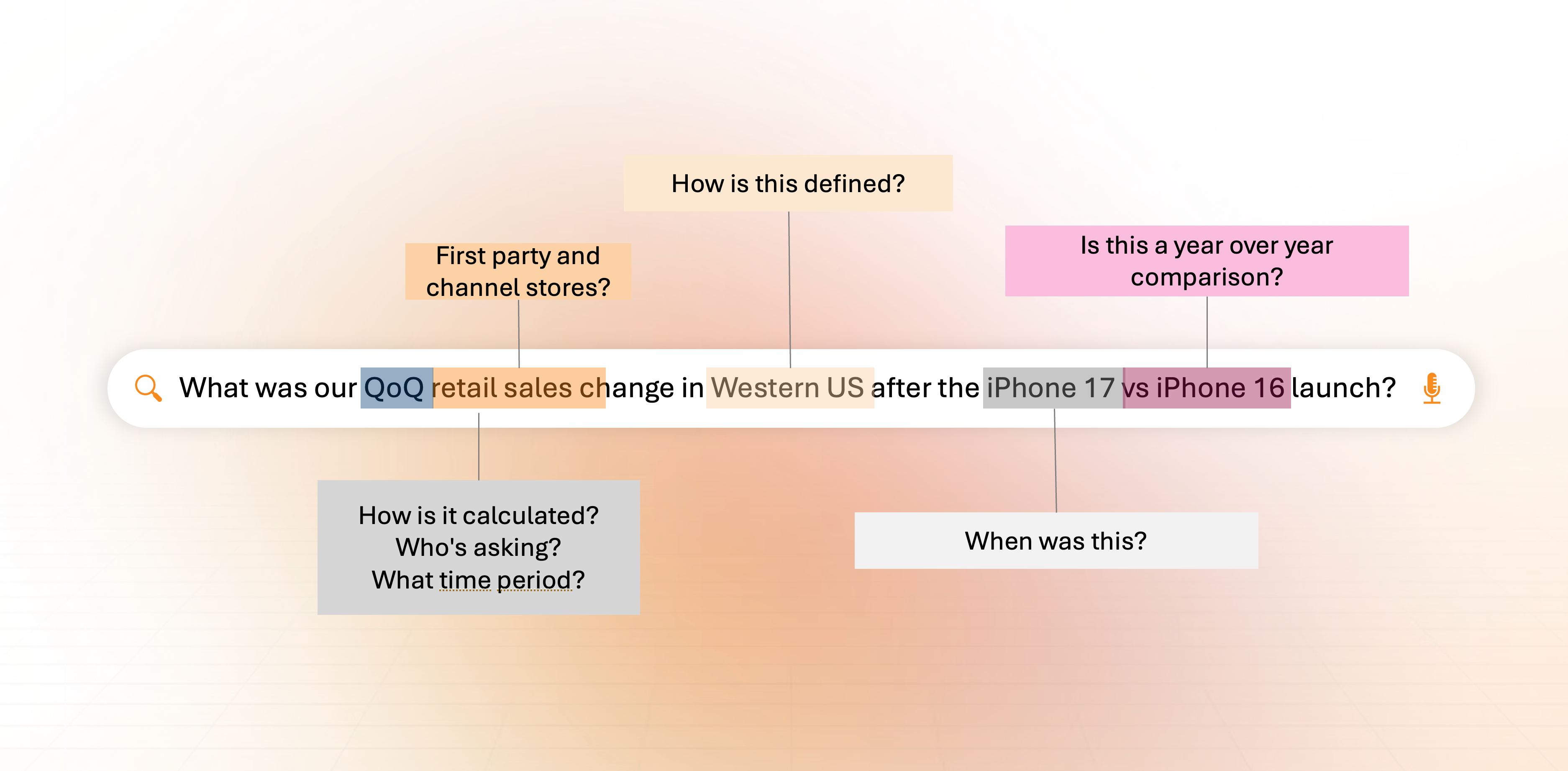
Let me explain why, starting from a question instead of a principle.
Twelve words. Any store manager gets it instantly. Now try to answer it. Which “region,” when the company has three? Is a combo drink an attach? Is “last quarter” calendar or fiscal? Do voids count? And which pepperoni, when four products share that name across the US, the UAE and India, a Margherita with pepperoni added counts, and “double pepperoni” is one pizza, not two?
Thirteen rules the user never said. Miss any one and the answer still looks right, and isn’t.
No LLM knows those rules. They are specific to your organization, and often different across systems inside the same organization. That knowledge is your context layer: objects and relationships, business definitions, business rules, synonyms. One customer of ours had over 400 definitions, 28 rules and 500-plus synonyms living in spreadsheets, report footnotes and a few analysts’ heads just for one simple use case. Some were not written down anywhere.
That is the keys to the kingdom for analytics and agents. The question is who holds the keys.
I started as a programmer 32 years ago. AI is the most transformational leap I have seen. But two thresholds decide when agentic AI takes off in the enterprise. The first is accuracy, and LLMs alone are not close to breaching it against enterprise data. The second is human behavior, which moves at the speed of mud.
Accuracy is the one we can fix. The hard truth is that most of AI’s accuracy never came from the model. It came from the context. When the model does not know which pepperoni you mean, it guesses. That is where trust in enterprise AI died.
The reflexis “we will put it all in the warehouse first.” A customer told me last week they have a three-year plan to move 15 platforms into Snowflake, and they will be agent-ready “once we have Snowflake.”
It does not have to be that way. Best case, a warehouse holds half your data. A context layer tied to one platform only sees what that platform sees, while your contracts, your ERP and your Salesforce instance sit outside it. The context layer has to span all of it, structured and unstructured, going to the source where it should and caching where it makes sense. That is the difference between agent-ready now and agent-ready in 2029.
Your warehouse offers a semantic layer. So does your CRM. So does your BI tool. Each is a click away, and trust me, they want you to click.
Now look at what those vendors are doing with API pricing. Free access gets metered. Two years from now you could be paying to reach definitions you wrote. CIOs tell me this fear unprompted, and they are right.
Two more costs follow. Fragmentation: your warehouse knows one definition of revenue, your CRM another, and your AI has to pick. Lost leverage: when your logic lives inside a vendor, switching means rebuilding, which weakens every negotiation you will ever have with them.
A few years ago, sovereignty meant one thing: do not expose proprietary data to the model. Now it also means which data center and which country, which regulations apply, and whether the model provider learns your business from the questions you ask. The context layer sits at the center of all three.
We make employees sign NDAs and non-competes, then hand our definitions, rules and tribal knowledge to a platform vendor with no equivalent protection. An employee who leaves takes some of your knowledge. A vendor holding your context layer holds all of it, in a format you may not be able to export, and can charge you to get it back.
Models are commoditizing in front of us. Enterprises already switch providers over token costs and contracts. More will run open-weight models on their own infrastructure. The reason to depend on any single cloud model goes down every quarter.
Locked inside a vendor, every model change is a migration project. Owned, it is a configuration change. Swap your data sources, your agent framework or your model; nothing in the context layer changes, and the model learns nothing new about your business, because the context sits between it and your data.
This is the design principle behind App Orchid:
Your context layer encodes how your business works. It is your IP. Own it, keep it behind your firewall, and keep it independent of every vendor around it. Enterprise AI is nowhere near maturity, and you do not hand a toddler the deed to the house.
Talk to App Orchid about building the context layer you own.


Experience a future where data and employees interact seamlessly, with App Orchid.
.png)