Who Should Own Your Enterprise Context Layer?
We hear it all the time.
Microsoft Fabric is a powerful data platform. It brings storage, analytics, and BI together under one roof. For teams modernizing their data estate, it can be a solid foundation. But for humans and agents needing immediate, conversational answers across a fragmented enterprise, infrastructure is only half the battle.
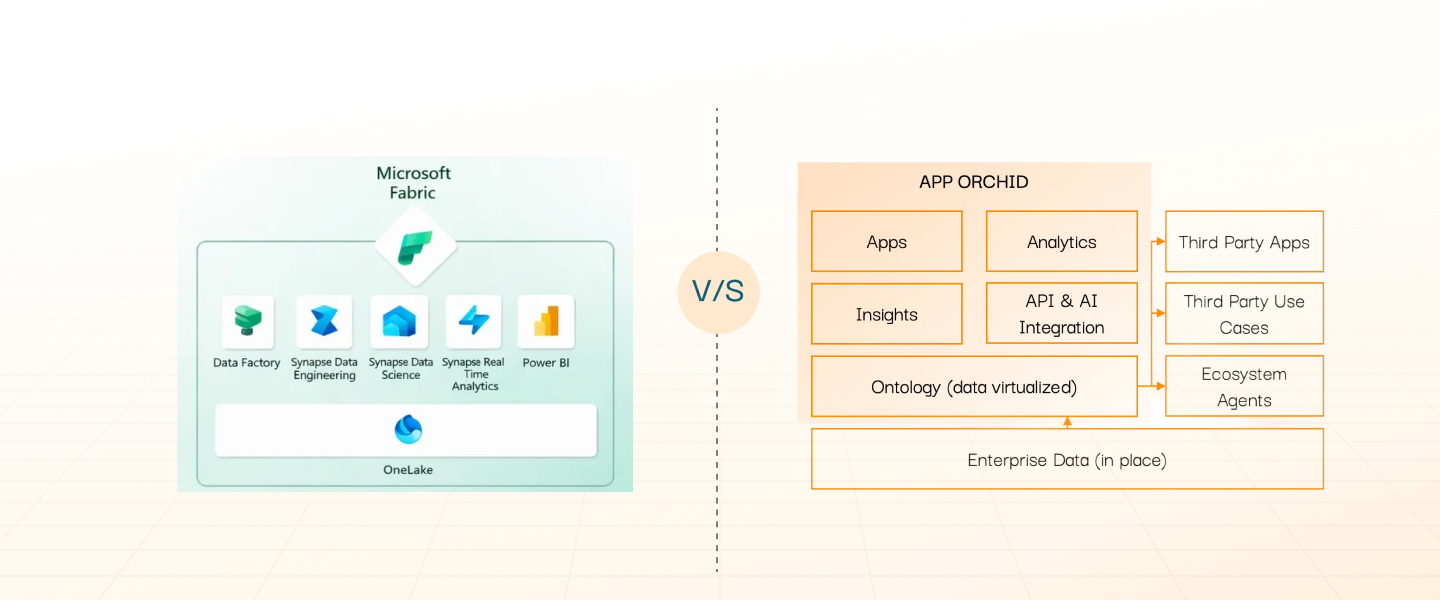
The difference between Microsoft Fabric and App Orchid is the difference between grocery shopping and having your meals prepped for you. One is a collection of ingredients that takes you time and effort to put together; the other is already assembled for you.
Fabric gives you the ingredients: data storage, pipelines, and BI tools. You still must decide what to cook, prep everything yourself, and make it all work together.
App Orchid delivers something ready to use. The intelligence is automatically assembled so your business can start asking questions immediately.
Both are useful. They just solve very different problems.
Microsoft’s introduction of Fabric IQ is an important signal. It confirms what the market is learning quickly: AI needs an ontology-based semantic layer to work at an enterprise scale.
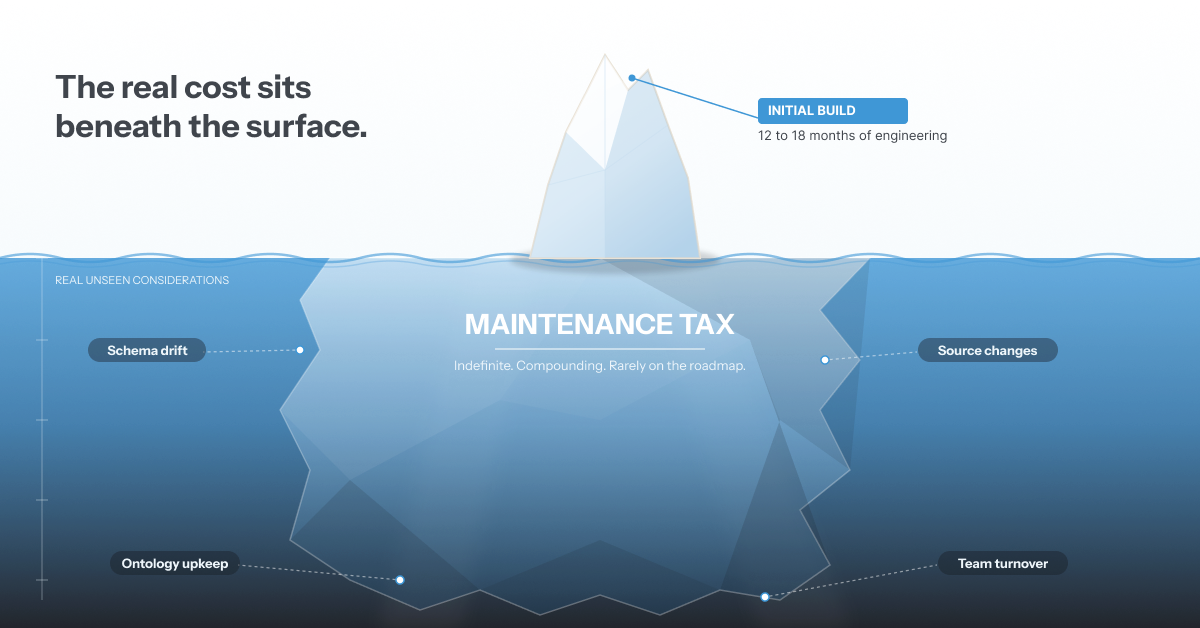
However, in Fabric IQ, building that ontology is largely manual. Data engineers and BI developers must explicitly define entities, properties, and relationships - effectively hard-coding your business’s meaning into a proprietary system.
That work is:
Data isn't enough. You need meaning and maintaining meaning by hand doesn’t scale.
App Orchid flips the model.
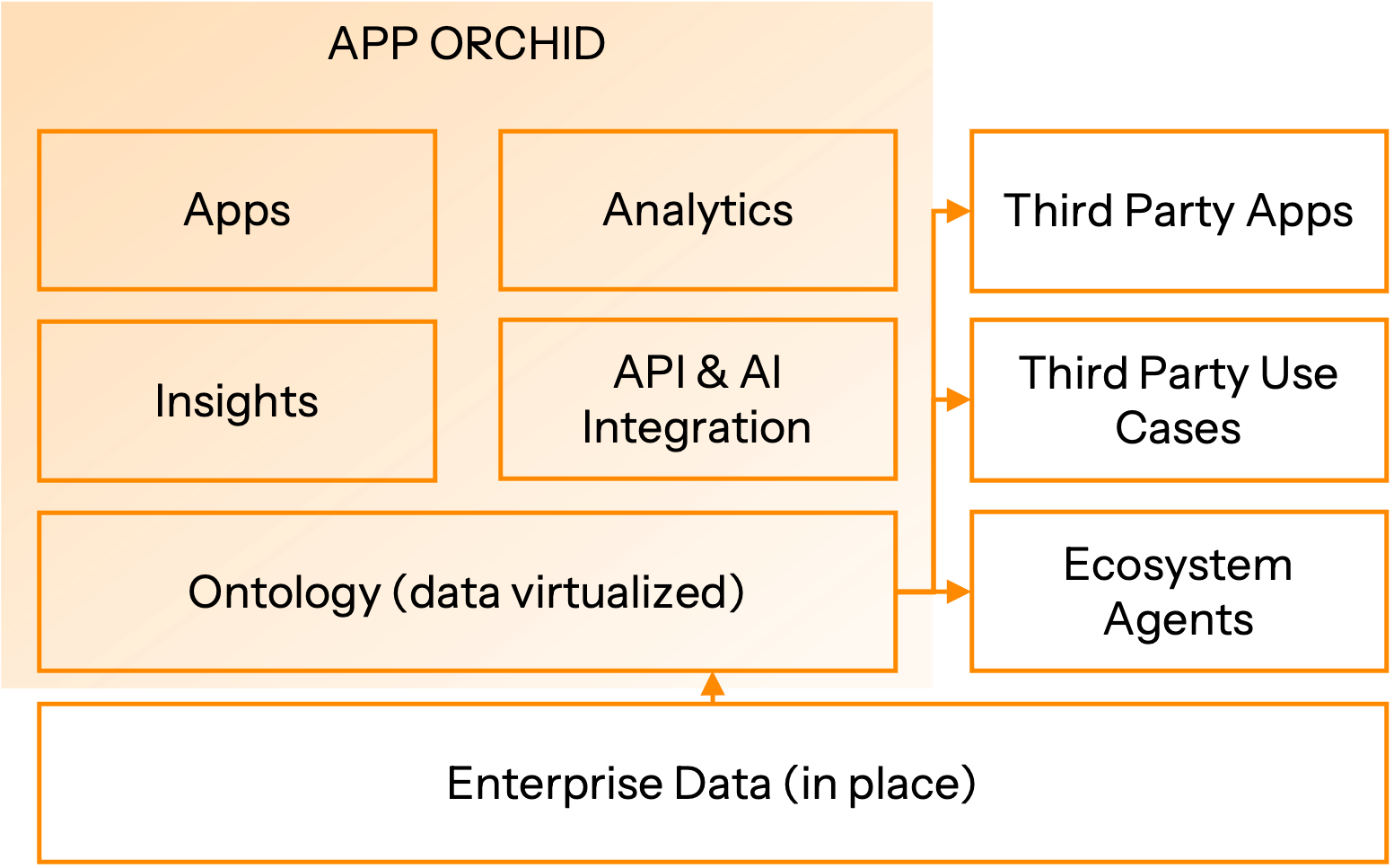
Instead of asking teams to manually define meaning, we use automated ontology discovery and enrichment. The platform reads your schema, analyzes the data, and proposes a candidate ontology automatically. Cryptic headers become human-readable business terms. Relationships are inferred. Context is surfaced and meaning and clarity is given to your data.
Humans stay in the loop to validate and refine, but the heavy lifting is automated, which is why teams move faster and get better results.
Fabric is designed around centralization. To get the most value, data is typically moved or co-located in OneLake. That can make sense for some modernization projects, but it also introduces migration work, duplication, and higher total cost of ownership.
App Orchid is federated first and built for AI.
Your data stays where it lives today. In ERP systems, CRMs, existing data lakes, cloud or on-prem. We provide a virtualized intelligence layer that works across silos without forcing a rip-and-replace of your infrastructure. This virtual intelligence layer will keep your business semantics intake even if you migrate to source systems or onboard new software.
When you look at real-world implementation timelines, the difference becomes clear:
Fabric is a platform for managing your data. App Orchid is the enterprise brain that sits on top of it.
There’s another difference that matters more as AI moves into production: ownership. You can’t own the best AI models – you connect to what OpenAI, Anthropic and Google provide. As will your competitors.
But you can own the meaning of your data. When business logic is buried inside a single hyperscaler ecosystem, you lose AI sovereignty. Meaning becomes proprietary.
With App Orchid, you own your semantics. Our semantic graph is built for an open ecosystem and will support Open Semantic Interchange (OSI) as specifications are finalized. Your business definitions stay yours, independent of cloud provider, data source, or downstream tools.
Picking a winner is not the right move because App Orchid and Microsoft Fabric fulfill two distinct, complementary roles within an enterprise data ecosystem, separating foundational infrastructure from active business intelligence.
Microsoft Fabric operates as a centralized data platform that unifies storage, pipelines, and engineering tools within OneLake, providing a robust architecture for data estate modernization. However, Fabric requires manual hard-coding of data meanings and relationships through Fabric IQ, which is slow, costly, and dependent on scarce technical talent. By contrast, App Orchid functions as a federated context layer that operates over existing, fragmented data silos without forcing costly migrations. It utilizes automated ontology discovery to instantly infer context and schemas, delivering ready-to-consume, conversational AI insights in a fraction of the implementation time.
Deploying both platforms together creates a powerful dual-architecture that eliminates the trade-offs of choosing one over the other.
Relying solely on Fabric can delay business value by up to a year due to heavy engineering prerequisites, while relying exclusively on App Orchid may bypass necessary, long-term hardware and storage modernization. Combining them allows Microsoft Fabric to serve as the structural data foundation while App Orchid sits on top as the intelligence layer, automating semantic definitions and ensuring vendor-agnostic data sovereignty. This hybrid approach allows organizations to modernize their data infrastructure while immediately unlocking fast, trusted, and portable enterprise AI insights.
App Orchid is the connective tissue that turns raw data into usable, trustworthy knowledge and finally makes enterprise AI work the way it was promised.


Experience a future where data and employees interact seamlessly, with App Orchid.