From Promise to Proof: What Enterprise AI Must Deliver in 2026

From Promise to Proof: What Enterprise AI Must Deliver in 2026
What we are seeing across enterprises right now is simple: AI is failing because it can’t be trusted.

For the last two years, enterprises have poured money, talent, and executive attention into a promise: “Talk to your data.” Whether the interface was a human analyst, a chatbot, or an autonomous agent, the expectation was the same: ask a question, get the right answer, move the business faster.

What we’re seeing now is a gap between AI ambition and business reality. Projects stall and trust erodes. Teams revert to spreadsheets and intuition. And what’s ironic is: people are using more AI in their personal lives than their work lives. At work, we see marginal productivity gains when AI helps with making presentations, marketing content, and emails. Perhaps a few talented engineers have embraced vibe coding, and there are glimmers of progression. However, the overarching sentiment is that it’s not substantially changing workflows or delivering business value at the level the hype suggests. And the uncomfortable truth is this:

At enterprise scale, “talk to your data” has not translated into better decisions, faster execution, or accurate, consistent, repeatable outcomes. Not because the ambition was wrong. It’s because the outcomes never materialized.

2026 is the year enterprise AI stops being optional and starts being judged. We are moving from an era of demos and promises to an era where the rules around AI, like governance, accountability, security, and ownership, decide whether AI gets adopted and whether it delivers measurable outcomes.

The End of First-Generation “Enterprise GenAI”

If you look back and ask, “How did we get here?” It's a bit of a journey. Before the ChatGPT world arrived about 2–3 years ago, most enterprises weren’t even thinking about talking to their data this way. Then, large language models (LLMs) showed up, and people thought, “This is the answer to everything.” Then LLMs exploded into the mainstream with many organizations assuming the missing piece was retrieval: connect an LLM to enterprise content using a vector database and RAG (retrieval-augmented generation), and you will unlock conversational intelligence across the business.

The belief became: “a combination of vector + LLM + RAG solves my problem.” This is where companies have spent tens of millions of dollars individually, only to land at a place where they’re not getting the accuracy, consistency, and scale they want. Most organizations that tried to solve this have now concluded: this solution will not work.

Over the last 18–24 months, teams have tried at scale, and they keep hitting the same wall:

  • Accuracy drifts
  • Answers are inconsistent
  • Results don’t scale across systems, roles, or governance requirements

The problem isn’t only that the answers are occasionally wrong, but that the business can’t rely on them. When leaders can’t trust outputs, decisions are slow. When governance teams can’t control access, risk rises. When results don’t scale, pilots never become platforms.

Incremental improvements to retrieval won’t fix a structural issue.

The Missing Layer: Shared Meaning From Semantic Layer to Ontology

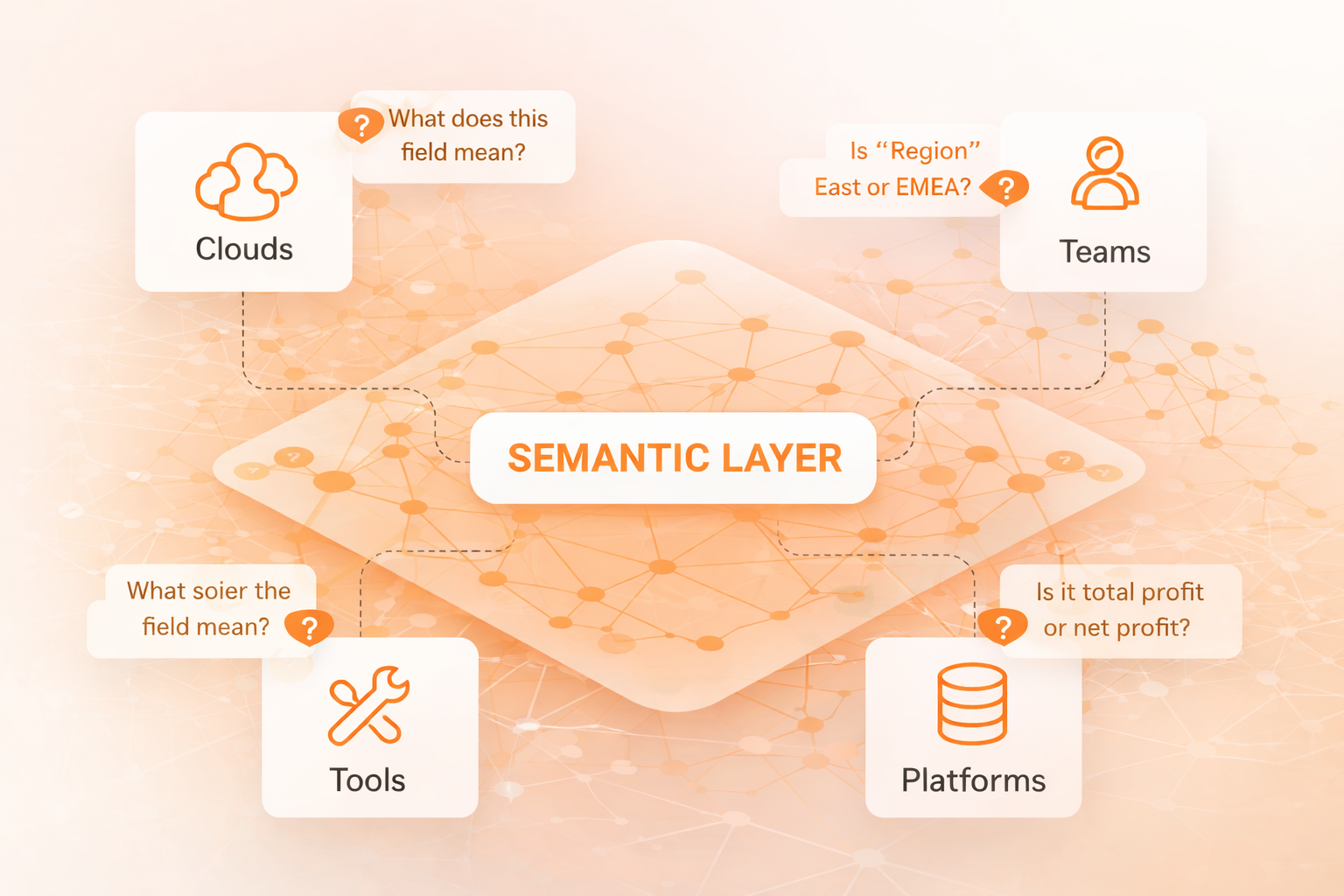
AI initiatives fail because enterprises rarely have shared meaning across their data, including across teams, tools, clouds, and time. Humans compensate for this by asking follow-up questions, interpreting context, and knowing what metric matters in this quarter, for specific roles, under certain conditions. AI can’t reliably answer those questions if the meaning isn’t captured and the context isn’t fully understood, or if meaning exists only in people’s heads, dashboards, or tribal knowledge.

That’s why the conversation has shifted. Not long ago, it was, “What is a semantic layer?” Now it’s, “How fast can we get value and what approach actually works across the business?” Most semantic layers were built for earlier generations of analytics and fall short of what AI needs to be effective. The reality for many is that their semantic layer describes data. It doesn’t capture intent, encode relationships, or reflect business reasoning. Critically, legacy semantic layers don’t enable reasoning, and this is a critical barrier to intelligence.

In 2026, having “a” semantic layer won’t be enough. The question is whether your semantic foundation can support inference, governance, and trust at scale.

That’s why I believe App Orchid is in a beautiful position. From my standpoint, we’re the only company solving the semantic intelligence problem at scale, and, along with it, the data federation problem (where data lives in many disconnected, siloed systems). We solve it elegantly, delivering the value customers deserve quickly.

It’s not a coincidence that suddenly everyone is talking about ontologies. Vendors are launching ontology builders. Platforms are rebranding metadata as meaning. But most of these approaches assume the same thing: That humans will manually build and maintain the enterprise’s understanding of itself.

That will not scale.

If AI requires humans to handcraft meaning, it will always lag the business. The real shift, and the one we’ve believed in from the beginning here at App Orchid, is this: AI should help build the ontology, not wait for it. This is done automatically and continuously, in a way that’s compatible with existing enterprise systems.

The New Enterprise Mandate: Ownership Over Meaning & AI Sovereignty

There’s another shift accelerating beneath the surface, and it will define AI strategy in 2026: Enterprises don’t need to own the AI model, but they must own the meaning that feeds it. The unfortunate reality is that the best AI models will continue to come from a handful of providers. What enterprises cannot afford to give up is:

  • Ownership of business definitions
  • Control over relationships between data
  • Governance of intent and access
  • Protection of IP, trade secrets, and institutional knowledge

Customers don’t want a point solution provider to own this. Many competitors are trying to create walled gardens where they own the data and its meaning. Customers are becoming aware of the trap: “If I’m in this cloud and that cloud, now I’m paying just to access my own data, and I still don’t own the meaning.” This is why independence matters. Our customers own the layer, they own the meaning, and they own the data. It is in their control, from security and governance to intellectual property ownership.

This is what AI sovereignty actually means. Training models directly on proprietary enterprise data is costly, risky, and just plain impractical. But capturing meaning within the confines of the business is achievable, defensible, and reusable across models.

For example, two companies can use the same LLM. The one that owns its semantic foundation will outperform the one that doesn’t. Because the model isn’t the advantage, the context is.

Why Intent and Role Matter

One of the most overlooked failures of first-generation enterprise AI is that it treats every question the same. But in real businesses, who is asking matters as much as what is being asked. A finance leader. An operations manager. A compliance officer. A salesperson. 

The simple test is: can a salesperson ask a natural-language question on their mobile about what their customer is doing and get an accurate answer without cutting through everything manually? And can we do it in a way that’s secure, governed for the enterprise? That’s the bar. They bring different intent, different permissions, and different definitions of “the right answer.”

Capturing intent and tying it to role, context, and meaning is what allows AI to reason instead of guess. That’s where accuracy stops being statistical and starts being operational.

What We’ve Believed from the Start

At App Orchid, our core belief from day one was simple: meaning is the hard part. The platform was built around creating an enterprise data ontology efficiently and capturing what data represents in business terms, not just technical metadata. We believed that shared meaning would become the limiting factor for analytics and, eventually, for AI.

We are no longer alone in this belief. It’s becoming the market consensus. The world is now demanding outcomes well beyond the experimental phase; the differentiator is no longer who can demo a chatbot.

It’s who can deliver:

  • Trusted answers
  • Consistent behavior
  • Governance-ready access
  • Fast time to value across fragmented enterprise data
What Will Separate Leaders in 2026

If you’re sitting with a CFO and a CIO going back and forth, my message is: first, you don’t have a choice. Your competition’s going to do it. It’s not “whether” you need to do this, it’s that you have to. The real question is: “How?” To answer this, you have to solve for three things: value (not technology for technology’s sake), accuracy, and security + governance. Find the fastest, most efficient way to satisfy those three, and execute.

As we move through this year, the winners won’t be the organizations with the most pilots. They’ll be the ones that align around a few fundamentals:

  • Trust over novelty: if the output isn’t reliable, it won’t be adopted.
  • Meaning over volume: more data doesn’t help if it isn’t understood.
  • Ownership over lock-in: enterprises will demand control of their semantic foundation.
  • Outcomes over infrastructure: AI must show measurable value quickly.

2026 isn’t the year of “more AI.” It’s the year the enterprise decides what it will tolerate and what it will no longer accept. And for the first time, the industry is converging on a simple truth: AI that actually works starts with data you can trust, meaning you can govern, and architectures you control.

That’s the future we’ve been ready for, and it’s here now.

The Best Path to
AI-Ready Data

Experience a future where data and employees interact seamlessly, with App Orchid.
REQUEST A DEMO