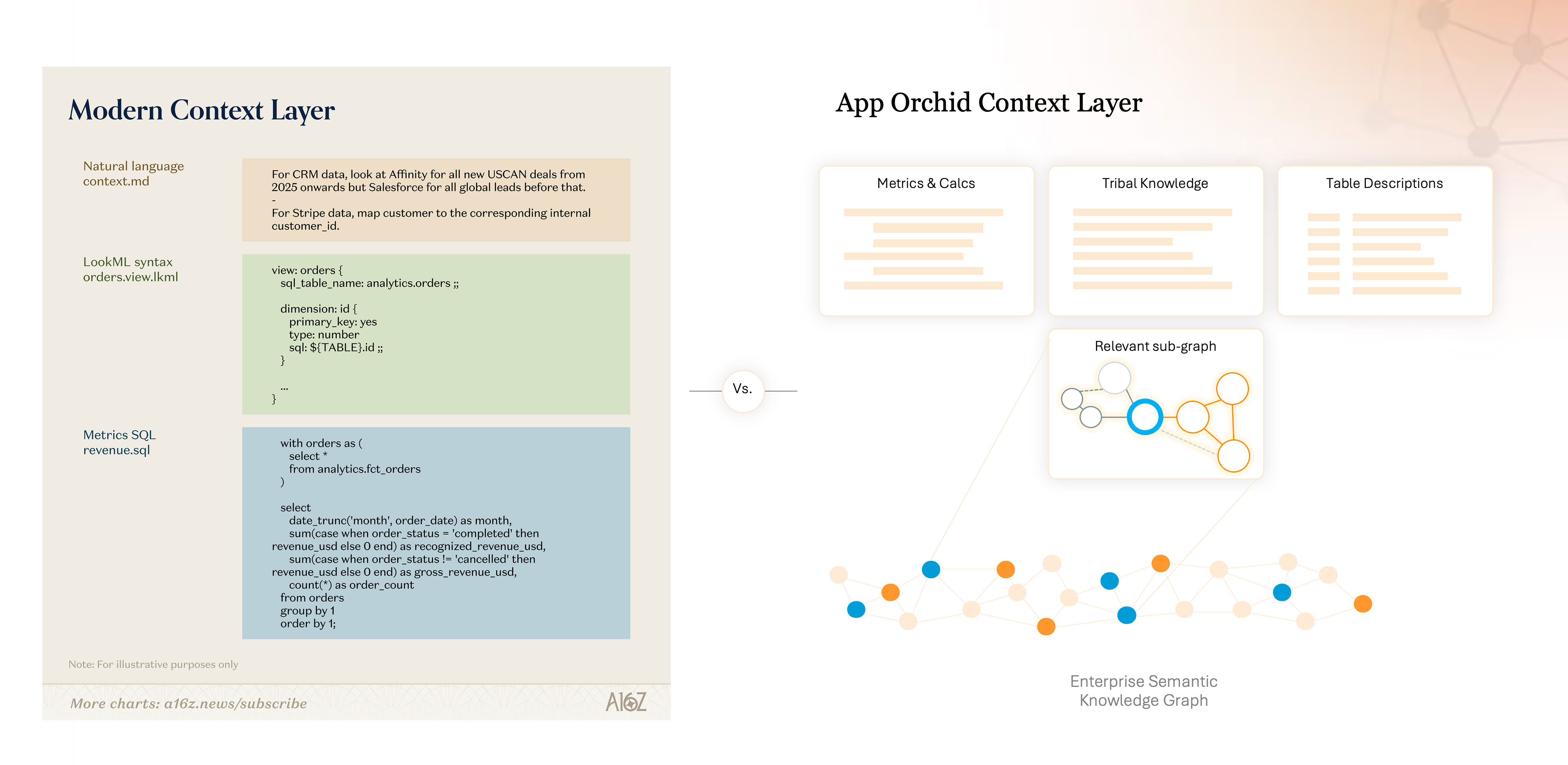
A version of a16z’s Modern Context Layer vision: The App Orchid Approach
March 11, 2026
Rehan Refai, Vice President Solutions
Most AI Projects Fail Because They Lack Business Context
Most AI projects fail because they lack business context. Large Language Models (LLMs) are smart, but they are generalists. They don't understand your unique data relationships or your "tribal knowledge." Connecting your data without enough context leads to objectively terrible answer quality. This article from Jason Cui and Jennifer Li at Andreessen Horowitz agrees with us.
The Shift: Why Traditional Semantic Layers Aren't Enough
Traditional semantic layers were built for BI tools. They are often static, rigid, and limited to structured data. Here is why they are inferior to a modern context layer:
Rigidity vs. flexibility: Traditional layers require manual, upfront modeling that breaks when the business changes. A context layer is dynamic and evolves with your data.
Structured vs. multimodal: Old approaches only handle SQL tables. A context layer incorporates "unstructured" data from Slack, PDFs, and emails.
Passive vs. agentic: Traditional layers just wait for a query. A context layer is designed for AI agents to navigate independently, providing the "guardrails" and logic they need to act on your behalf.
No tribal knowledge capture: No way to capture and encode what a human knows implicitly about the data semantics and business vernacular.
App Orchid solves this by building a semantic intelligence layer - a universal translator that sits between your data and your AI agents.
Here is how App Orchid maps to the five requirements of a modern, agentic data system.
1. Accessing the Right Data
"...the first order of business is ensuring all the right data is accessible. This is table stakes"
App Orchid acts as a data fabric. It doesn't require you to move all your data into one single warehouse. Instead, it connects to where the data lives.
Unified access: We connect to and enable data agent use cases across lakehouses, SQL databases, and SaaS apps.
Unstructured data: Our platform pulls in content from document repositories.
Breaking silos: It creates a single access point for an AI agent so the agent doesn't have to hunt for information across twenty different systems.
2. Automated Context Construction
"The benefit of using LLMs is that a lot of the initial context gathering can be done in an automated way... looking through past query history can be high signal."
Manual data modeling takes too long. App Orchid uses AI to accelerate the creation of the context generating semantic layer.
Relationship discovery: The system looks at your data schemas and query logs to figure out how tables actually relate to each other. We record this in an Ontology.
Semantic extraction: It identifies business objects like "Asset," "Risk," or "Contract" automatically.
Integration and generation: We ingest existing definitions to ensure we aren't reinventing the wheel. Additionally we rely on LLMs to generate descriptions and additional context (which is always validated by a human SME)
When an agent requests data, App Orchid knows the business context of the question, the role and the permissions of the agent, and the location of the data. This rich payload of context is utilized to
3. Human Refinement
"Human input provides the final crucial links that enable true agent automation... the context layer can become a multi-dimensional corpus where code lives alongside natural language."
Automation gets you 80% of the way there. Subject Matter Experts (SMEs) provide the final 20% that actually matters.
Low-code interface: App Orchid provides a workspace where business leads can add curations, guardrails, and logic without writing code.
Tribal knowledge mapping: If "USCAN deals" are handled differently than "Global leads," an expert can simply record that rule in the semantic layer.
Ontology management: This turns raw data into a living library of business logic that AI agents can read and follow.
4. Agent Connection
"Once the context layer is properly constructed, it just needs to be exposed to agents and accessible real-time. This can typically be done through API or MCP."
A context layer is useless if it's a walled garden. App Orchid is built to be agent-agnostic.
Semantic API: We expose the Context Graph via standard APIs.
Agentic ecosystem support: Model Context Protocol (MCP) is in an upcoming release, with Agent-to-Agent (A2A) communication, making your data context available to any orchestration layer like Google Agentspace or ServiceNow NowAssist.
Agent readiness: Whether you are using any custom-built agents, they connect to App Orchid to "ask" for the right data and the rules governing it.
Real-time retrieval: The system ensures the agent gets the most current version of the truth, not a stale extract.
5. Self-Updating Context Flows
"Data systems are never static and as a result the context layer shouldn't be either... In the case a data agent provides incorrect data... that should of course be incorporated back into the context layer."
Data changes. Business logic changes. Your context layer must evolve.
Feedback loops: When a user corrects an agent's output, App Orchid captures that correction. It can then update the semantic layer so the mistake doesn't happen again.
Continuous learning: The more your team interacts with the system, the smarter the underlying ontology becomes.
Semantic enrichment: We deploy an "always-on" agent that learns from every user interaction and validation, continuously refining the enterprise ontology and automating metadata enrichment to ensure the system gets smarter with every question asked.
App Orchid: Completing the Vision
While the industry identifies these five steps as the goal, App Orchid is already delivering the specialized features needed to make them work at scale.
Because we are an AI company, we sometimes use AI generated images.
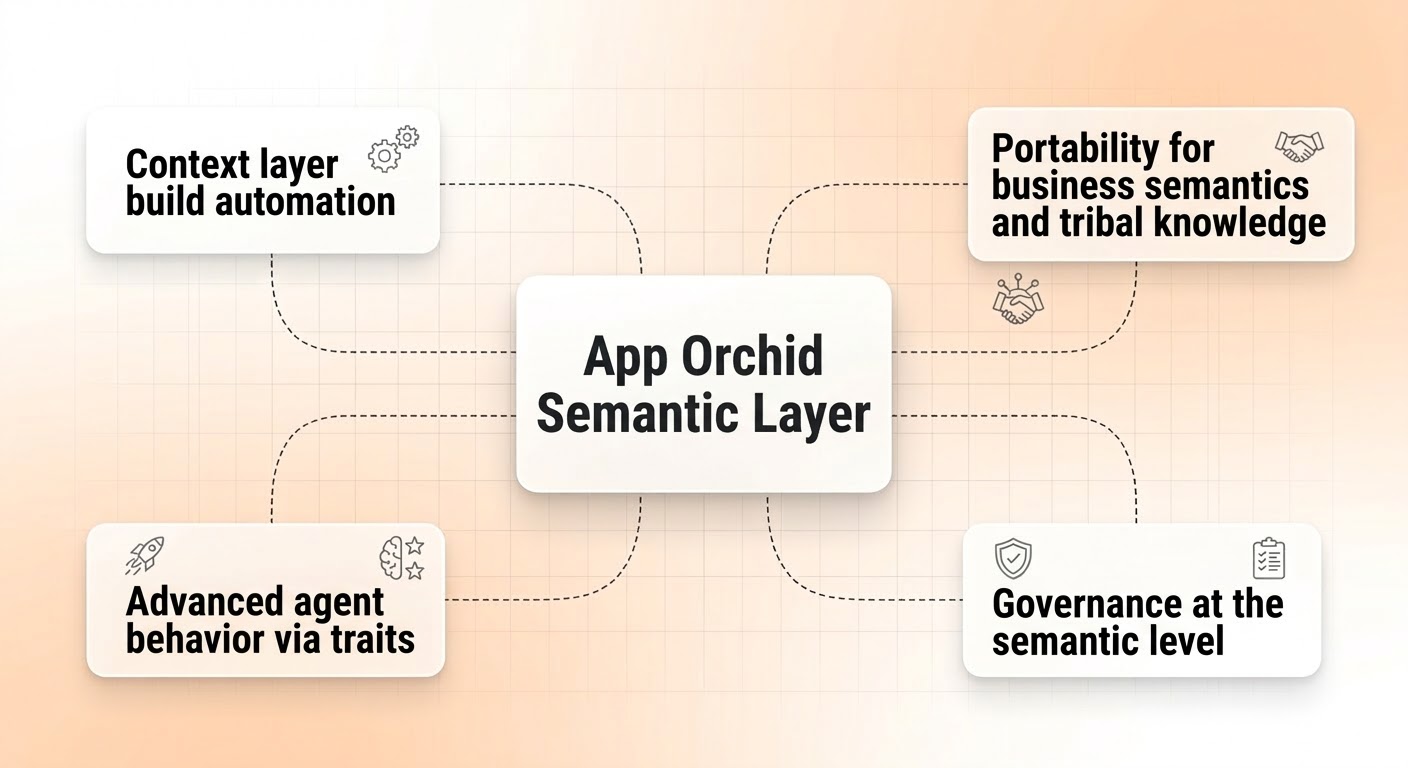
1. Context layer build automation
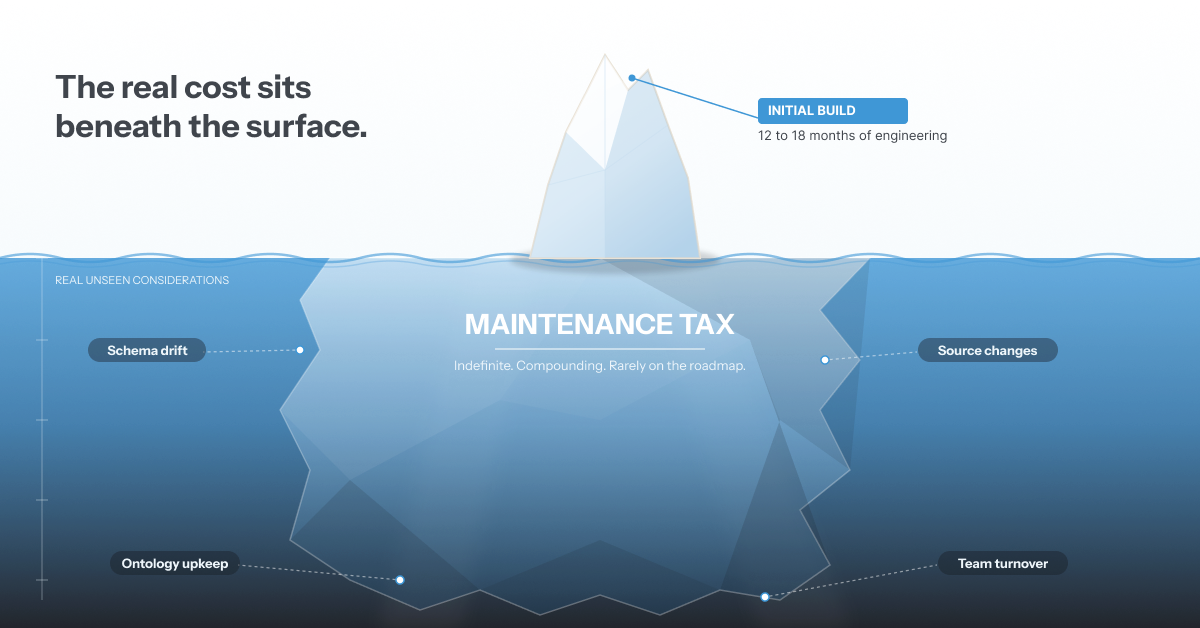
Building a context layer shouldn't require a fleet of consultants. App Orchid automates ontology construction by scanning and encoding existing data relationships and behaviors. We use LLMs to generate descriptions and mappings automatically, turning a many months-long modeling project into a self-bootstrapping process.
2. Portability for Business Semantics and Tribal Knowledge
Tribal knowledge is only valuable if it isn't locked in a specific vendor's silo. We make your business logic portable and vendor-neutral. Your context lives independently of your compute or storage. If you change your warehouse, your AI agents don't lose their context.
3. Enabling Advanced Intelligence via Traits
Context is useless if the agent doesn't know how to apply it. We use Traits — pre-defined behaviors that make agents tool-aware. For example, traits enable:
Geospatial Awareness: Agents understand geospatial data enabling them to reason about, for example, plant locations or vehicle paths.
Time Series Intelligence: Agents automatically detect trends, seasonality, and drift. Answer questions that require an understanding of time.
4. Governance at the Semantic Level
You cannot hand an AI the keys to the warehouse. App Orchid manages security within the context layer using Attribute-Based Access Control (ABAC). We enforce role, row, and column-level restrictions at the semantic level. This ensures every agent decision is traceable, auditable, and grounded in your specific safety guardrails.
Conclusion: The Architecture of Action
Data without context is just noise. AI without context is just a guess. To move beyond basic chatbots and toward truly autonomous agents, organizations must stop focusing solely on the model and start focusing on the context architecture.
App Orchid provides the infrastructure to turn your fragmented data into a unified, intelligent semantic asset. We help you capture the unwritten rules of your business and make them accessible to your AI. This is how you build AI that actually works for your business.