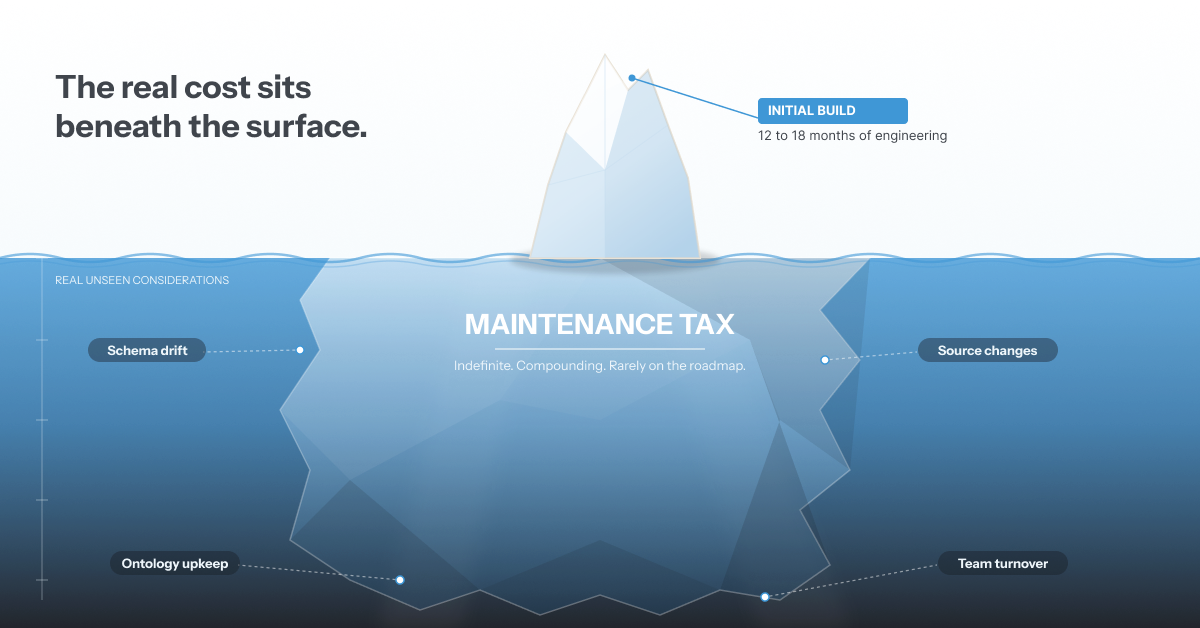
Who Should Own Your Enterprise Context Layer?

One theme has come up repeatedly in conversations with customers: organizations want to give more people access to AI-powered insights, but they also want confidence that the answers those systems produce remain aligned with how the business actually understands its data — AI guardrails.
Natural language analytics has made it easy for business users to ask questions and get insights instantly. Instead of navigating dashboards or submitting requests to data teams, employees can interact with data conversationally. That shift is accelerating as AI becomes more accessible and more embedded in everyday workflows.
But wider access also introduces a new challenge. When AI becomes the interface to enterprise data, how the system interprets questions matters a lot. That’s exactly the problem we set out to solve with our latest platform advancements.
We’ve introduced AI guardrails that allow organizations to control how large language models interpret user questions inside Easy Answers. These controls ensure that responses remain grounded in enterprise data definitions while still allowing users to explore insights conversationally.
The goal isn’t to restrict AI. It’s to make it possible for organizations to expand AI adoption safely across the enterprise.
AI is quickly becoming part of the way organizations access and analyze data. Teams want faster answers, fewer bottlenecks, and the ability to explore insights directly.
At Mobile World Congress 2026, technology leaders described the current moment as an inflection point in how intelligence is created and deployed. As the cost of AI drops, organizations are experiencing what one analyst called an “insatiable demand for intelligence” (Amiya Johar, Mobile World Live, MWC26 Barcelona).
That demand is visible across enterprise analytics. Instead of relying solely on dashboards or predefined reports, business users want to interact with data directly, asking questions, refining them, and exploring insights through conversation. For enterprises, this means AI-driven insights must remain accurate, explainable, and aligned with how the business defines its data.
One of the most important aspects of AI systems is something most users never see: Guardrails.
As the broader AI industry tries to figure out how to balance innovation with safety, businesses need to take greater control over how AI interacts with their data. They need to make sure it's aligned with their business definitions and operational guidelines. Guardrails enable them to do just that.
In a governed semantic layer, these guardrails are encoded as business rules — not LLM prompts — so they persist across every question, every user, and every system change.
Guardrails can help determine:
When those controls are clear and well designed, organizations can confidently allow more people to interact with data using AI.
One of the biggest challenges with conversational analytics is something we all deal with every day: language is messy and complicated.
A user might ask about “faulty meters.” Another might ask about “meter issues.” A human immediately understands those questions refer to the same thing. An AI system may not unless it is guided by the enterprise definitions behind the data.
Without interpretation controls, answers can drift away from how the business actually defines its information. When that happens, trust disappears quickly. App Orchid addresses this challenge by introducing LLM Interpretation Modes that anchors responses to the organization’s enterprise semantic layer and it controls how much freedom the LLM actually has to interpret.
What is important to note for most enterprises is that not every user should have the same level of AI interpretation flexibility. Operational teams often require highly controlled answers aligned strictly with enterprise definitions. Analysts, on the other hand, may benefit from more interpretive freedom when exploring patterns or investigating trends.
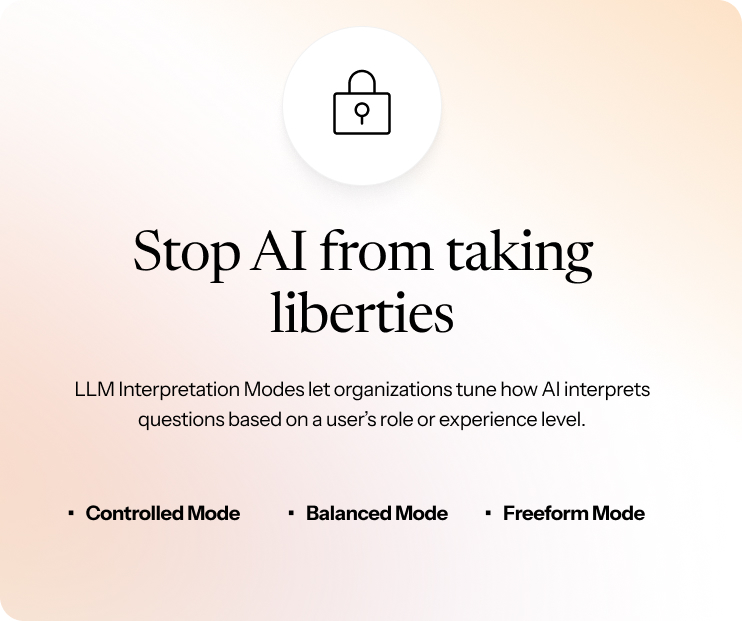
LLM Interpretation Modes allowing organizations to tune how AI interprets questions depending on the user’s role or level of experience.
Each mode anchors LLM reasoning to the enterprise ontology — ensuring that the context layer, not the model's probabilistic inference, determines what your business terms mean. This role-based approach allows organizations to expand AI access across teams while ensuring insights remain consistent and trustworthy.
AI makes it easier than ever to ask questions about enterprise data. The harder part is ensuring the answers remain aligned with how the business defines that data.
With App Orchid and Easy Answers, organizations can implement AI guardrails that adapt to user roles and experiences. This flexibility enables enterprise organizations to structure AI-assisted work accordingly, from workgroups that need comprehensive structure to power users who need the ability to explore business data more freely.
The result is broader AI adoption across teams while maintaining insights that remain consistent, reliable, and trusted. Get in touch with App Orchid to learn how you can use our new Guardrails capabilities to operationalize AI across your organization.


Experience a future where data and employees interact seamlessly, with App Orchid.