Who Should Own Your Enterprise Context Layer?
"We already built our data platform. Why do we need you?"
A data leader at a global life sciences company asked us this because his team had spent years building the data foundation and their internal demo looked great.
So, we asked him five questions that we think every company should be asking of any agentic initiative. He couldn't answer any of them.
Because nobody measures these things, let alone thinks of them as metrics to measure. Demos are built on clean, curated questions. The reality is that production data and systems are messy, repetitive, cross-functional, and governed. This is where AI struggles to get into production.
The stakes are higher than they look. Most enterprises are already spending on AI without clear ROI. ROI doesn't come from copilots that suggest the obvious. It comes from agents that act: approve the order, flag the shipment, reroute the supplier.
An agent can only act on answers you trust. You can only trust answers that are right every time, fast enough to run inside a workflow, cheap enough to scale, and safe enough to pass a security review.
Enterprise AI comes down to one question: can you get accurate information from your siloed data to your LLMs and agents?
If the answer is no, your AI initiative is a pilot or an experiment. And your board continues asking where the ROI is.
If you're building an AI data agent in-house or evaluating a vendor, these are the five questions to ask first.
Ask: On real enterprise questions, not a curated demo set, how often is the answer correct?
Why it matters: An agent that's right 70% of the time isn't an agent. It's a draft generator. Someone still has to check every answer. That kills the ROI case before it starts.
What good looks like: 90% or higher, measured with a method you can see. Ask how the test set was built. Ask whether it includes questions that span multiple systems.
What is a good accuracy rate for an AI data agent? For production use, at least 90% on real business questions. Below that, humans have to review every output, and the agent can't safely act on its own.
Ask: If I ask the same question 10 times, do I get the same answer 10 times?
Why it matters: Accuracy without consistency is luck. An agent that gets the right answer on Monday and a different one on Tuesday can't be trusted to act. Neither can the reports built on it.
Most teams test accuracy once and stop. LLMs are non-deterministic. Without a layer that pins down definitions, the same question can take a different path through your data each time.
What good looks like: The 90/90 standard. At least 90% accurate and at least 90% consistent. Anything below either line isn't ready for production.
Why does consistency matter for enterprise AI? Agents that take action need repeatable answers. If the same question returns different results, no one can audit the decision, and no one will trust the next one.
Ask: How long does the median question take to answer?
Why it matters: Agents don't ask one question. They typically chain dozens. A 20-second answer is barely tolerable in a chat window. Inside a multi-step workflow, it's fatal.
In our benchmarks, a leading platform-native agent took 19 to 21 seconds at P50, and still missed the 90/90 line. App Orchid answered in 1.5 to 2.5 seconds, above 90/90 across the leading models.
What good looks like: Low single-digit seconds at P50, with the same accuracy and consistency.
What is P50 latency and why does it matter for AI agents? P50 is the median response time: half of answers come back faster, half slower. Agents run many queries per task, so a slow P50 multiplies into workflows that take minutes instead of seconds. For context, App Orchid answers 90% of questions in tests under 2.5 seconds.
Ask: Not a simple question about one table. A real one. "Which customers with late shipments also have open service cases?" How many tokens does that take?
Why it matters: Real business questions cross objects: customers, orders, shipments, invoices, cases. Each hop adds additional context that cost tokens. Token costs grow quietly, then show up all at once on the bill.
Most teams test with single-object questions. Then they roll out to users who ask cross-object questions all day.
What good looks like: A predictable, published token cost per cross-object question. App Orchid averages about 2,370 tokens per question and renders explanations and sources without spending tokens at all. Leading competitors can use 100k-130k tokens for complex questions.
Why do AI agents get expensive at scale? Because real questions span many data objects. Without a context layer that resolves relationships up front, the LLM reasons through raw schemas every time, and token use climbs with every join.
Ask: When a user asks a question, does the agent enforce that user's permissions in every source system it touches?
Why it matters: An agent with a service account sees everything. So does everyone who asks it a question. That's a data leak waiting to happen. Security and audit teams know it, and they'll block the rollout.
What good looks like: User identity flows from the question to every source, with row- and field-level controls respected. Every answer is traceable: which system, which records, which logic.
How do AI agents handle data permissions? A production-ready agent passes the asking user's identity through to each source system and applies the same access controls that user already has. It never answers from data the user couldn't see directly.
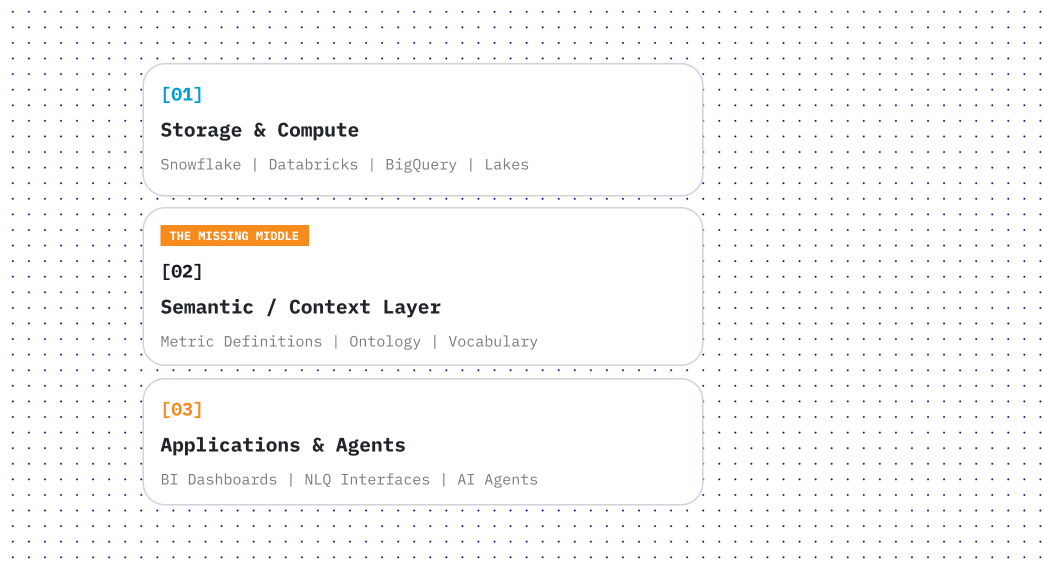
Every major data platform now promises context for AI. Snowflake and Databricks both offer semantic models, metric definitions, and catalog metadata for their agents. That's progress. It isn't enough.
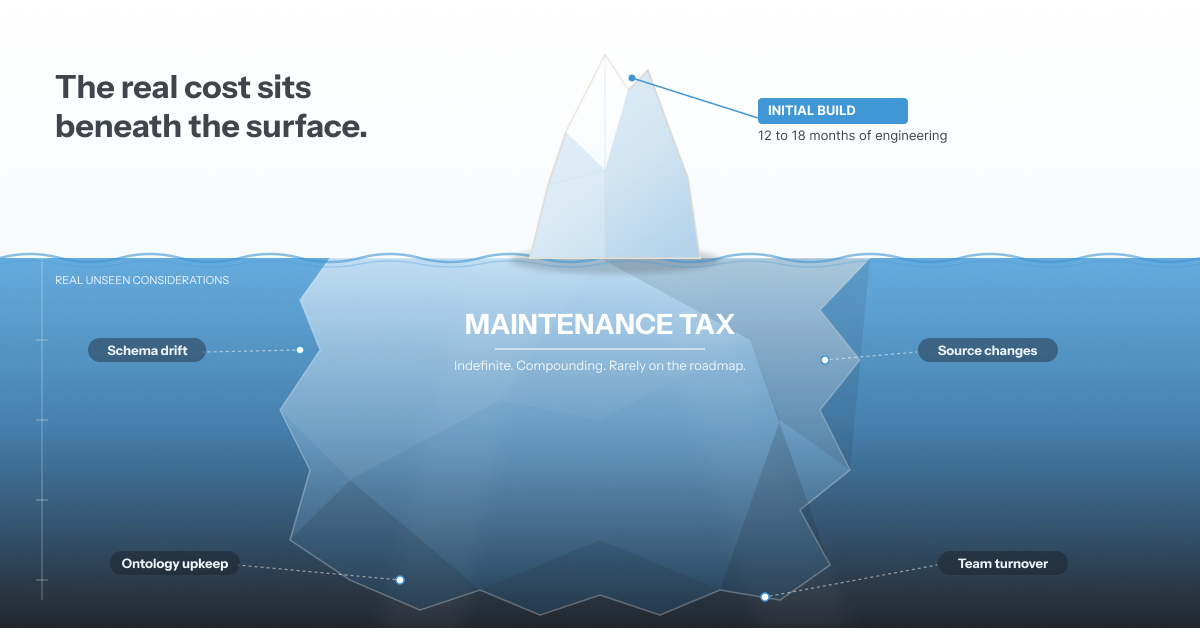
Take a simple question: "How many shipments did we send to this customer last quarter?" Does "customer" mean the ship-to party or the sold-to party? In most enterprises, they're different records in different systems, and not all of them live in the warehouse. A platform's semantic model only knows what someone has defined inside that platform, it’s typically limited technical metadata or inferred from unstructured content. For everything else, the LLM guesses.
That guess is where accuracy, consistency, speed, and cost all break down at once. It's why a leading platform-native agent in our benchmarks took 19 to 21 seconds per answer and still missed the 90/90 line.
App Orchid takes a different approach. Its context layer spans your systems utilizing its graph technology, not just one platform, and captures what platform metadata doesn't: business definitions, relationships across sources, and the domain knowledge that lives in people's heads. Agents resolve meaning up front instead of guessing from raw schemas. That's how App Orchid clears 90/90 in 1.5 to 2.5 seconds.
App Orchid doesn't replace Snowflake or Databricks. It sits alongside them, and the rest of your systems, and gives your AI the context those platforms can't supply on their own.
If your agent can't answer all five, it isn't ready to act. It might be ready to demo.
The data leader from the opening didn't need a new data platform. He needed a way to make the one he had trustworthy for AI. Most teams are in the same place.
See how App Orchid scores on all five.


Experience a future where data and employees interact seamlessly, with App Orchid.